

The quickest way to become a better airgun shooter is not a new rifle or a bigger scope. It is regular, structured practice on good airgun targets, behind a safe backstop, with a notebook to keep you honest.
This guide walks you through target practice at home and on the range in Pakistan, from building a safe backyard or rooftop setup to choosing shooting targets, rests and pellets. You will learn how a pellet trap and backstop work, why ricochets off hard surfaces are a real risk, which target types suit which drills, and how to run simple practice routines that show measurable progress week by week.
In This Guide
- Setting up a safe backyard or rooftop airgun range
- Backstops, pellet traps and avoiding ricochets
- Choosing airgun targets: paper, stickers, splatter faces and reactive targets
- Shooting rests, bipods and bags for benchrest practice
- Practice drills that actually improve your groups
- Pellet choice, eye protection and tracking your progress
- A step-by-step session checklist and FAQs
Safety First: Setting Up Target Practice at Home
An air rifle pellet can travel much further than most new shooters expect, and it can still injure a person or break a window well beyond your target distance. Before you hang a single target, think about where every pellet will go if you miss.
Pick the Right Direction
- Never shoot toward roads, streets, gates, neighbours' homes, rooftops or open plots where people may walk unseen.
- Shoot toward a solid wall or earth bank on your own property, ideally with nothing behind it but more wall.
- On a roof, shoot downwards or level into a backstop, never upward or over the parapet. A pellet that clears a roof wall can land streets away.
- Keep the shooting lane clear. Children, pets and visitors should stay behind the firing line, and nobody walks forward to check targets until every gun is unloaded and set down.
Check the Rules Where You Live
Rules about airguns differ between cities, cantonment areas and housing societies, and some communities simply do not allow shooting inside residential boundaries. Check with your local authorities and your housing society before setting up, and be considerate about noise, especially with louder spring-piston guns. Remember that shooting at birds or animals from a rooftop is not target practice: hunting in Pakistan is regulated by provincial wildlife departments, so contact them about licences, seasons and protected species before you hunt anything.
Backstops, Pellet Traps and Ricochet Risk
A backstop is whatever stops the pellet after it passes through the target. A pellet trap is a box placed directly behind the target to catch pellets, usually with an angled plate or a dense filler inside. Together they turn a risky backyard into a controlled range.
What Makes a Good Pellet Trap
- A sturdy box made of thick wood or metal, larger than your target so near-misses are still caught.
- A soft, dense filler that absorbs pellets rather than bouncing them back. Many shooters use layers of old carpet, thick cardboard, rubber or tightly packed cloth.
- An angled plate in commercial-style traps that deflects pellets down into a collection area instead of straight back at you.
- A solid wall behind it as a final safety layer.
Check your trap regularly. Fillers wear out, and a pellet that punches through a worn-out section will hit whatever is behind it. Empty collected lead with gloves and wash your hands afterwards.
Why Ricochets Are a Real Danger
Pellets bounce off hard, flat surfaces. Concrete floors, brick, tiles, stones, metal sheets, glass and even still water can send a pellet back toward the shooter or sideways toward someone else. Never shoot at bottles placed on a concrete wall. If you see pellets coming back out of your setup, stop immediately and rethink it.
Choosing Airgun Targets
Different targets do different jobs. Paper shows you exactly where each pellet went, reactive targets keep practice fun, and stickers let you set up fresh aiming points in seconds. Most shooters end up using all three.
Paper and Sticker Targets for Grouping
Paper records every shot so you can measure groups, check your zero and spot patterns like vertical stringing. Self-adhesive stickers stick on cardboard, wood or an old target card.
- The orange target roll with 100 bullseye stickers is ideal for long sessions, with neon orange aiming points in a 2 inch or 3 inch option.
- The red 2cm shooting target stickers come 18 to a sheet and make a precise small aiming point for scope zeroing and small-group work.

Splatter Targets: See Hits Without Walking
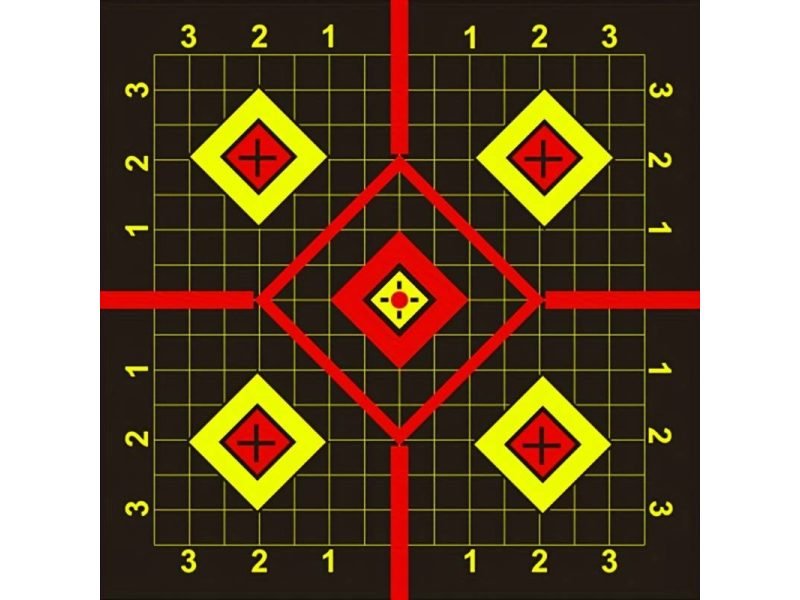
Splatter targets show a bright fluorescent ring around each hole, so you can see your hits through a scope or even with the naked eye at short range. Less walking also means fewer chances for someone to be downrange.
- 8 inch adhesive splatter bullseye targets (pack of 10) are a strong all-round choice for zeroing and grouping.
- The fluorescent 20 x 20 cm target papers include 4 target styles in a pack of 10.
- The squirrel-pattern fluorescent targets are useful for practising shot placement on an animal outline before hunting season.
Spinners and Knock-Down Reactive Targets
Reactive targets such as spinners, knock-down silhouettes and resetting plates give instant feedback with a satisfying clang or movement. They are great for holdover practice. Use only targets designed for airguns, follow the maker's guidance on distance and power, and angle the face so pellets deflect downward, not back at the firing line. Always place reactive steel in front of a proper backstop, and always wear eye protection when shooting at metal.
Slingshot and Archery Crossover
Many families who set up a backyard range also shoot slingshots or bows. The same principles apply: a safe backstop, a clear lane and visible targets. A beginner frame such as the laser-aimed resin slingshot with a spirit level can share your sticker targets, and you will find more frames and bands in our slingshots section. Archers should shoot into a proper archery boss; see the archery range for target faces and accessories. Never shoot arrows or slingshot ammo into a pellet trap that was not built for them.
Shooting Targets Compared
| Target type | Best for | Pros | Watch out for |
|---|---|---|---|
| Plain paper / bullseye | Grouping, zeroing, scoring | Records every shot, cheap | Hard to see small holes at distance |
| Self-adhesive stickers | Fresh aiming points, quick setups | Stick on cardboard or old cards | Need a flat backer |
| Splatter targets | Scope zeroing, longer distances | Hits visible from the firing line | Use up faster on high-volume days |
| Spinners / knock-downs | Holdover, fun drills, kids | Instant feedback | Ricochet risk; eye protection essential |
Shooting Rest, Bipods and Bags for Benchrest Practice
To learn what your rifle and pellet can really do, you need to remove as much human wobble as possible. A good shooting rest lets you test pellets, zero a scope and build confidence.
Rest Bags and Bench Rests
- The portable front and rear gun rest bag set ships unfilled and light, and you fill it with sand through the built-in funnel hole. The 600D Oxford cloth is soft on your stock.
- The MTM KSR-30 K-Zone shooting rest weighs about 4 pounds, has a handwheel elevation system and non-marring rubber pads, and can be used as a front rest or handgun rest by removing the rear pad section.
A note for spring-piston shooters: springers recoil in two directions and often shoot differently when rested hard on a bag. Try resting the forend on your open palm on the bag (the artillery hold). PCP and CO2 guns are far less fussy.

Bipods and Shooting Sticks
- The UTG adjustable precision bipod extends from 6 to 9 inches with 5 notched leg positions and mounts via a Picatinny adapter, which suits prone and bench work.
- For standing or kneeling practice, the LIT V-mount shooting stick bipod extends from 65cm to 120cm and works on rough or hard ground.
You will find more rests and bipods in our shooting accessories section, and the team at the Just Hunters shop in Gulberg, Lahore, can help you check which mount fits your rifle's rail.

Pellet Choice for Tight Groups
Every barrel has its favourite pellet, and the only way to find it is to test on paper from a rest. Buy small tins of a few quality domed or target pellets, shoot several 5-shot groups with each at the same distance, and keep the one that groups best. Do not mix pellet types in one session.
For .22 PCP and powerful rifles, the H&N Field Target Trophy .22 pellets are a medium-weight 14.66 grain pellet with a flat trajectory over medium ranges, offered in head sizes from 5.53 to 5.55 mm.
If you are still deciding on calibre, read our .177 vs .22 airgun pellets guide, and browse the full pellets and BBs range.

Practice Drills That Improve Your Airgun Target Shooting
Each drill focuses on one skill, so you can see where you are improving and where you are stuck.
1. The 5-Shot Group
From a rest, fire five careful shots at one small aiming point, such as a 2cm sticker. Measure the group from the outside edges of the two widest holes, then subtract one pellet diameter to get centre-to-centre size. Shoot three groups and record the average. This is your baseline for both rifle and pellet.
2. Positional Shooting
Once your bench groups are consistent, shoot the same drill prone, sitting, kneeling and standing. The difference between your bench group and your standing group shows how much of the error is you. Large standing groups are normal; that is where most improvement happens.
3. The Distance Ladder
Set targets at several known distances within your safe backstop, for example short, medium and the longest distance your setup allows. Fire a group at each and note how the point of impact moves.
4. Holdover Practice
Using your distance ladder notes, practise holding over or under on targets at distances other than your zero. A scope with a target reticle helps; the Vector Optics Sentinel 6-24x50 E-SF has an illuminated MP target reticle and side parallax focus down to 15 yards, which is useful for short airgun ranges. Our rifle scope buying guide explains reticles and parallax in more detail.
5. Timed Drills
Give yourself a fixed time to load, aim and fire a set number of shots at small stickers. Timed drills reveal whether your fundamentals hold up under mild pressure. Never let speed override safe handling; the muzzle stays pointed at the backstop at all times.
Track Your Progress with a Shooting Notebook
After each group, write down:
- Date, location and weather (wind, light, temperature)
- Rifle, scope settings and pellet type with head size
- Distance, position and rest used
- Group size and where it landed relative to the aim point
- One thing that went well and one thing to fix next time
Good records also tell you when your rifle needs attention, because a sudden change in accuracy is often a sign the barrel needs cleaning or a screw has worked loose.
Eye Protection and Responsible Use
Wear shooting glasses every time you shoot, and make sure everyone watching wears them too. It matters most with steel targets and hard surfaces. Treat every airgun as loaded, keep your finger off the trigger until on target, store guns unloaded and out of children's reach, and supervise young shooters closely.
Step-by-Step Checklist for a Safe Practice Session
- Confirm shooting is allowed where you are and that neighbours will not be disturbed.
- Check the lane: no roads, homes or people beyond or beside the target area.
- Inspect your pellet trap and backstop for wear; replace worn filler.
- Remove or cover any hard surfaces near the target that could cause ricochets.
- Fix fresh airgun targets or stickers to a flat backer in front of the trap.
- Set up your shooting rest, bag or bipod at the firing line.
- Put on eye protection, and hand glasses to anyone watching.
- Load only at the firing line, with the muzzle pointed at the backstop.
- Run your drills, recording each group in your notebook.
- Unload, call a clear range and set guns down before anyone goes forward.
- Collect targets, wash your hands and store everything away.
Frequently Asked Questions
What are the best airgun targets for beginners?
Self-adhesive splatter targets are a great start because hits show up clearly around each hole, so you can correct your aim without walking to the target after every shot. Pair them with a roll of bullseye stickers for small aiming points. Paper records every shot honestly, which helps beginners measure groups and track progress. Add reactive targets later once your basic accuracy and safe habits are in place.
How do I make a pellet trap at home?
Use a sturdy wooden or metal box larger than your target and fill it with soft, dense material such as layers of old carpet, thick cardboard, rubber or tightly packed cloth. Fix the target to the front and place the box against a solid wall. Check the filler regularly and replace worn sections, empty collected lead with gloves, and stop if pellets ever bounce back.
Is it safe to practise airgun shooting on a rooftop?
It can be done responsibly only with a proper backstop, a clear lane and shots fired level or downward into a pellet trap, never over a parapet or toward roads and neighbours. Pellets travel far and ricochet off concrete and brick. Check your local and housing society rules first, keep people behind the firing line, and wear eye protection every session.
Which shooting rest is best for airgun target practice?
For benchrest work, a front and rear rest bag set or an adjustable rest gives a stable, repeatable platform for testing pellets and zeroing scopes. A bipod suits prone shooting and rifles with a Picatinny or M-LOK rail. Spring-piston rifles often group better with the forend resting on your open hand on the bag rather than directly on the rest.
What distance should I practise at with an air rifle?
Start close, where you can see results clearly, and build a distance ladder out to the longest range your backstop safely covers. Zero your scope at a distance that suits your intended use, then shoot groups closer and further away to learn holdover. The right distance always depends on your space, your rifle's power and having a safe backstop behind every target.
Do I need eye protection for airgun shooting?
Yes. Shooting glasses should be worn by the shooter and everyone nearby, every time. Pellets and fragments can bounce back from hard surfaces, metal reactive targets and pellet traps, and eyes are easily injured. Eye protection is cheap insurance, and it is especially important for children and spectators who may be standing closer to the targets than they realise.
Conclusion
Good practice is simple: a safe lane, a solid backstop and pellet trap, the right airgun targets, a steady shooting rest and a notebook to track every group. Start from the bench, move to positional and holdover drills, and let your records guide your next step. When you are ready to build your setup, browse targets, rests and pellets from Just Hunters online and order with cash on delivery anywhere in Pakistan, or visit our Gulberg, Lahore shop for advice. For rifle ideas, see our guide to the best airguns for target shooting in Pakistan.