

You have a new scope out of the box and the rifle is on the table. What you do next matters more than the scope's brand or magnification. Knowing how to zero a scope properly is the difference between tight groups and wasted pellets. A good scope on loose rings will still throw shots wide.
This guide walks through the full job in the order we do it at the bench. It covers choosing scope rings and mounts, fitting a scope stop on a spring-piston airgun, setting eye relief, levelling the reticle, tightening screws evenly and bore sighting. It then covers zeroing at 25-30 m for an air rifle or 100 m for a centrefire rifle, with the MOA and MRAD click maths so you know exactly how far to turn the turrets.
Still choosing an optic? Read our rifle scope buying guide for airguns in Pakistan first.
In This Guide
- Scope rings and mounts: dovetail vs Picatinny/Weaver
- Tube size, ring height and one-piece vs two-piece mounts
- Scope stops for spring-piston airguns
- Scope mounting step by step
- Bore sighting before you fire
- How to zero a scope at 25 m, 30 m and 100 m
- MOA and MRAD click maths
- Common mistakes, checklist and FAQs
Choosing Scope Rings and Mounts
Good scope mounting starts with rings that match three things: the rail on your rifle, the diameter of the scope tube, and the height needed to clear the barrel.
11mm Dovetail vs Picatinny/Weaver Rails
Most air rifles and many rimfires have an 11mm dovetail, two angled grooves cut into the top of the receiver that the mount clamps onto from the sides. Some guns use a slightly narrower 3/8 inch dovetail, so check yours before ordering.
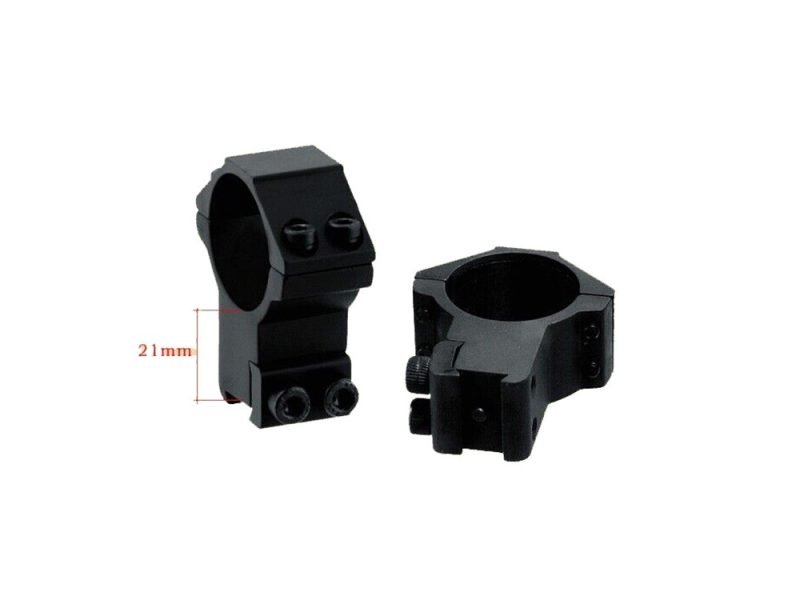
Picatinny and Weaver rails are the flat, slotted rails, about 21mm wide, found on most centrefire rifles and many PCP airguns. Picatinny slots are standardised; Weaver slots can vary. Picatinny rings generally fit Weaver rails, but Weaver rings will not always fit Picatinny. Dovetail and Picatinny mounts are not interchangeable.
Tube Size: 1 Inch, 30mm or 34mm
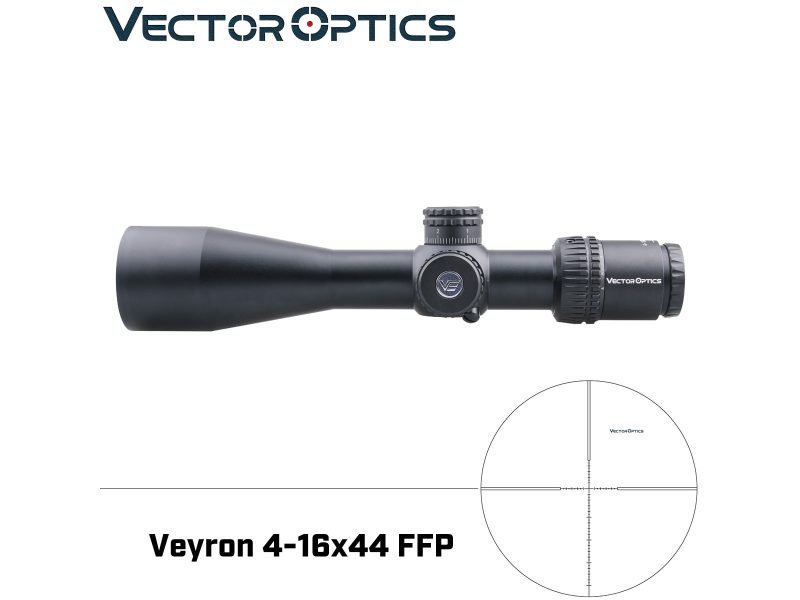
Rings must match the scope tube exactly: 25.4mm (1 inch), 30mm or 34mm. The Discovery VT-R 3-9x40 AC uses a 1 inch tube, the Vector Optics Veyron 4-16x44 SF FFP a 30mm tube, and the Discovery HD 5-30x56 SFIR FFP Zero Stop a 34mm tube. Check the spec sheet and never force a tube into the wrong rings.
One-Piece vs Two-Piece Mounts
Two-piece mounts are two separate rings. They are light and let you space the rings freely. The Discovery Optics 1 inch high profile 2 PC dovetail mounts and the Discovery 30mm high profile 2 PC mounts are typical air rifle choices.
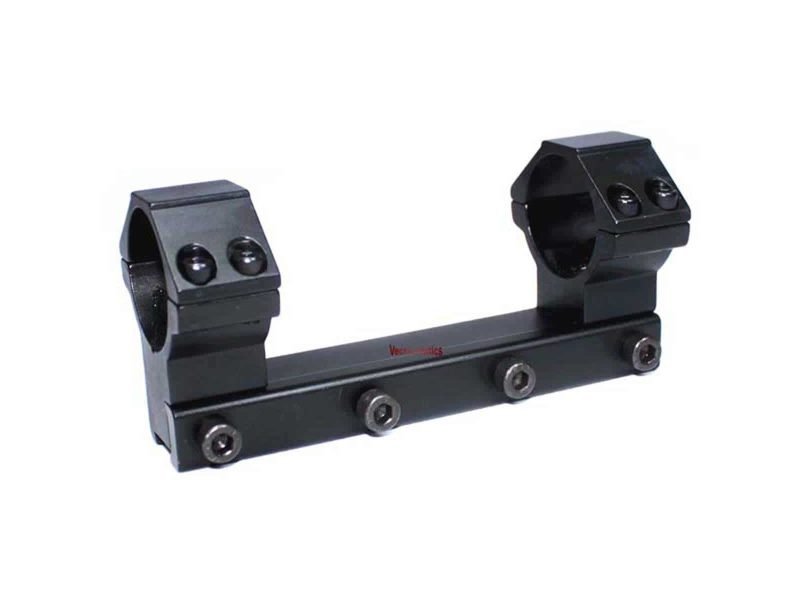
One-piece mounts join both rings to a single base, so the rings are already aligned and the long base resists creep. The Vector Optics 30mm one-piece long 11mm dovetail mount has a 120mm base, about 78mm between rings and an anti-shock pin. On Picatinny rails, the cantilever Arken Optics ARP30 rigid precision mount moves the scope about 2.5 inches forward for eye relief on AR-style rifles, with a 20 MOA option for long range.
Choosing Ring Height
Use the lowest rings that let the objective bell clear the barrel, and the eyepiece clear the bolt or loading port. As a rough guide, 32-40mm objectives often suit low or medium rings, while 44-56mm objectives usually need medium or high. PCP rifles with tall magazines may need high rings regardless.
| Mount type | Fits | Strengths | Watch out for |
|---|---|---|---|
| Two-piece dovetail rings | 11mm dovetails | Light, flexible spacing | Need aligning; can creep on springers without a stop |
| One-piece dovetail mount | 11mm dovetails | Pre-aligned rings, long base, often a stop pin | Fixed ring spacing |
| Picatinny/Weaver rings | 21mm rails | Recoil lug locks into slot; strong and repeatable | Weaver rings may not fit Picatinny |
| One-piece cantilever | Picatinny rails | Moves scope forward; built-in MOA options | Heavier; mainly for AR-style rifles |
Scope Stops for Spring-Piston Airguns
Spring-piston and gas-ram airguns recoil twice: a shove backwards, then a sharp forward jolt as the piston stops. That jolt makes dovetail mounts slide back along the rail, so the zero wanders.
The fix is a scope stop, a pin that drops into a hole on the receiver so the mount cannot slide. The Hawke one-piece high mount for 30mm tubes has a recoil stop pin on its 9-11mm version and a reversible clamp for 9-11mm or 3/8 inch dovetails. Seat the pin firmly in the stop hole, pushed to the rear edge, before tightening. If your rifle has no stop hole, a bolt-on stop block behind the mount does the same job. Check the receivers in our spring piston airguns range.
Scope Mounting Step by Step
Work with the rifle unloaded (airgun uncocked and uncharged), held steady in a padded rest.
1. Fit the Bases
Wipe oil off the rail and rings. Fit the bases loosely with the stop pin or recoil lug engaged.
2. Set Eye Relief
Lay the scope in the rings with the caps loose. Turn it to highest magnification, where eye relief is least forgiving. Shoulder the rifle in your normal position and slide the scope until you see a full image with no black ring at the edge. The Discovery VT-R 3-9x40 AC, for example, lists about 85-92mm of eye relief. On centrefire rifles, err slightly forward so the scope cannot hit your brow under recoil.
3. Level the Reticle
A tilted reticle means the elevation turret no longer moves straight up, so shots drift sideways at longer range. Level the rifle first with a bubble level on the rail or action. Then rotate the scope until a second level on the flat top of the elevation turret cap also reads level.
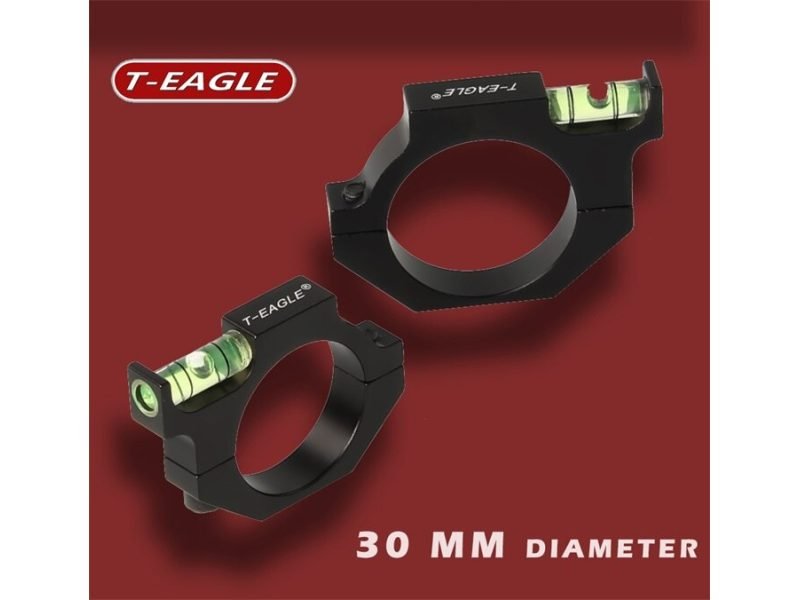
A scope-mounted level then helps you hold the rifle level in the field. Options include the T-Eagle metal spirit bubble level for 25.4mm or 30mm tubes, the 21mm Weaver card slot bubble level for 21-22mm rails, and the Vector Optics SCACD-10 anti-cant device for any flat surface.
4. Tighten Evenly: Torque Basics
Over-tightened rings can dent a tube or bind its adjustments; loose rings let it creep. Follow the ring maker's torque specification (or the scope maker's, if lower), ideally with a torque driver.
- Tighten the base clamps first, pushing the mount against the stop or lug.
- Tighten cap screws a little at a time in a cross (X) pattern, keeping the gap even on both sides.
- Recheck the reticle level afterwards.
- Check all screws again after the first 20-30 shots.
Bore Sighting Before You Fire
Bore sighting roughly aligns the reticle with the barrel so your first shots land on paper. It saves ammunition but is not a zero.
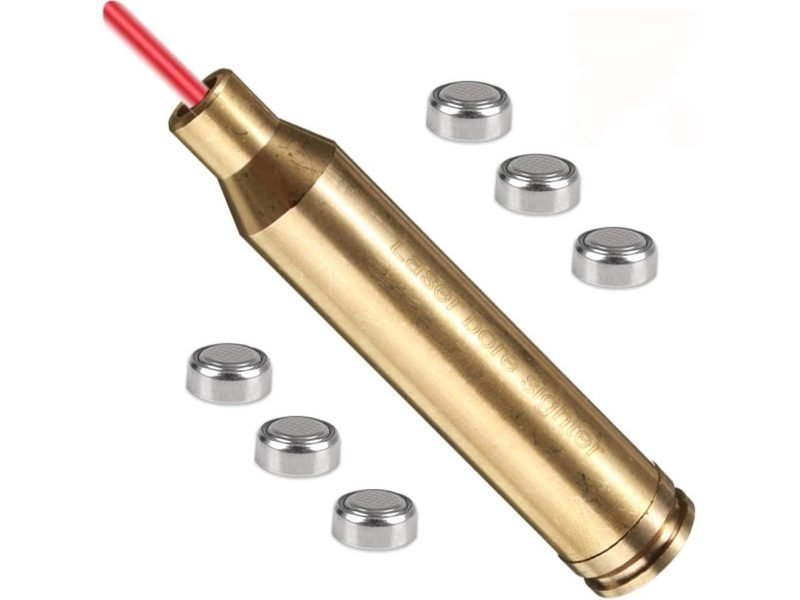
For firearms, a cartridge-style laser bore sighter sits in the chamber and projects a dot downrange. The Rotchi 7mm laser bore sighter fits 7mm Rem Mag chambers and lists a 15-100 yard sighting range, while the Vector Optics 12 gauge cartridge laser bore sighter suits 12GA shotguns. See our laser bore sighters for other sizes. With the rifle resting steady, turn the turrets until the crosshair sits on the laser dot.
Safety: remove the bore sighter before loading, never dry-fire with it in the chamber, and never point the laser at anyone's eyes.
Cartridge bore sighters do not fit airguns. Instead, fire your first pellet at about 10 m onto a large target, then move out to your zero distance.
How to Zero a Scope: The Shooting Process
Here is how to zero a scope once it is mounted: adjust the turrets so that, at one chosen distance, point of impact matches point of aim.
Pick Your Zero Distance
- Air rifles: 25 m or 30 m is the usual choice when zeroing an air rifle scope, as it gives a useful spread of close and mid-range distances for pest control and field shooting.
- Centrefire rifles: 100 m is the common reference, and it keeps click maths simple.
Zero with the exact pellet or load you will actually use.
Set Parallax and Focus
Focus the eyepiece on a plain bright background until the reticle is crisp. If the scope has an adjustable objective or side focus, set it to the target distance so the reticle does not "float" when you move your head.
The Zeroing Steps
- Place a target with a clear aiming mark at your zero distance, with a safe backstop.
- Shoot from a solid rest with the same hold every time. Springers prefer a light, consistent "artillery hold".
- Fire a group of 3 to 5 careful shots at one aim point.
- Measure the vertical and horizontal distance from the group centre to the aim point.
- Work out the clicks needed (below) and turn the turrets in the marked direction, "UP" or "R", to move impact that way.
- Fire another group and repeat until the group centre sits on the aim point.
- Reset the turret caps to zero if your scope allows it.
Clicks, MOA and MRAD Adjustment Maths
Clicks are angles, so one click moves impact further at longer range. A common error when zeroing an air rifle scope is using 100 m values at 25 m.
MOA Scopes
One MOA is about 2.9 cm at 100 m, 0.87 cm at 30 m and 0.73 cm at 25 m. So a 1/4 MOA click, as on the Discovery VT-R 3-9x40 AC, moves impact only about 0.18 cm at 25 m. The Discovery HS 6-24x50 SF FFP uses finer 1/8 MOA clicks.
Example: group 5 cm low at 25 m, 1/4 MOA clicks: 5 / 0.18 = about 27 clicks UP.
MRAD (MIL) Scopes
One MRAD is 10 cm at 100 m, so a 0.1 MRAD click is 1 cm at 100 m, 0.3 cm at 30 m and 0.25 cm at 25 m. The Vector Optics Veyron 4-16x44 lists 1/10 MIL (1 cm) clicks.
Example: group 3 cm right at 30 m, 0.1 MRAD clicks: 3 / 0.3 = 10 clicks LEFT.
| Click value | At 25 m | At 30 m | At 100 m |
|---|---|---|---|
| 1/8 MOA | approx. 0.09 cm | approx. 0.11 cm | approx. 0.36 cm |
| 1/4 MOA | approx. 0.18 cm | approx. 0.22 cm | approx. 0.73 cm |
| 0.1 MRAD | 0.25 cm | 0.30 cm | 1.0 cm |
Always check the click value marked on your turret. Scopes also have limited adjustment range; the Discovery VT-R 3-9x40 AC lists 35 MOA. If you need a huge number of clicks to reach zero, recheck your scope mounting before winding the turret to its limit.
Confirming Your Zero
One good group is not a confirmed zero. Shoot a final 5-shot group in a later session to make sure it holds, and recheck springers after a few tins of pellets as mounts settle. Then note your holdovers at other distances.
Common Scope Mounting and Zeroing Mistakes
- Canting: tilting the rifle pushes shots sideways and low, worse with distance. Level the reticle and use a bubble level.
- Over-tightening: can crush a tube or bind adjustments. Follow the torque spec and tighten in a cross pattern.
- Parallax not set: causes shifting groups that look like a mounting fault.
- Switching ammunition: a different pellet or load can move impact, so re-zero.
- Dirty barrel: see our airgun cleaning and maintenance guide.
Scope Mounting and Zeroing Checklist
- Rifle unloaded; airgun uncocked and uncharged.
- Rings match rail (11mm dovetail or Picatinny/Weaver) and tube (1 inch, 30mm or 34mm).
- Scope stop engaged on spring-piston guns.
- Eye relief set at highest magnification.
- Rifle levelled, then reticle levelled.
- Screws torqued to spec in a cross pattern; level rechecked.
- Bore sighted (laser for firearms, 10 m first shot for airguns).
- Groups shot at 25-30 m or 100 m, adjusted with correct click values.
- Zero confirmed in a second session and holdovers recorded.
A note on responsibility: firearms in Pakistan require a valid licence, and hunting is regulated by provincial wildlife departments through licences, open seasons, bag limits and protected species. Check with your provincial department before any hunt, and only zero at a safe range with a proper backstop.
The Just Hunters shop in Gulberg, Lahore stocks scope mounts and accessories and rifle and airgun scopes, and you can order online with cash on delivery across Pakistan. Target shooters may like our best airguns for target shooting in Pakistan.
Frequently Asked Questions
What distance should I zero my air rifle scope at?
Most airgun shooters zero at 25 or 30 metres. Because pellets fly in a curved path, a zero at this range usually keeps impacts close to the aim point over typical pest control and field target distances. The best distance depends on your rifle's power and pellet, so after zeroing, test at several ranges and note how far above or below the aim point each shot lands.
How many clicks do I need to move my scope at 25 metres?
Divide the distance you need to move by what one click is worth at that range. A 1/4 MOA click moves about 0.18 cm at 25 metres, and a 0.1 MRAD click moves 0.25 cm. So a group 5 cm low needs roughly 27 clicks up on a 1/4 MOA scope, or 20 clicks up on a 0.1 MRAD scope. Always check your turret's marked click value first.
Do I need a scope stop on a spring piston air rifle?
Yes, in most cases. Spring-piston and gas-ram airguns have a sharp forward jolt that makes dovetail mounts creep backwards along the rail, so your zero shifts shot by shot. A stop pin that drops into the receiver's stop hole, or a separate stop block behind the mount, prevents this. Many one-piece airgun mounts include a stop pin for exactly this reason.
Should I use one-piece or two-piece scope rings?
Both work well when fitted properly. One-piece mounts have pre-aligned rings and a long base that resists creep, making them a popular choice for springers and precision setups. Two-piece rings are lighter and let you space the rings freely, which helps with scopes that have short tube sections. Choose based on your scope's shape, your rail type and how hard the rifle recoils.
Can I use a laser bore sighter on an airgun?
Cartridge-style laser bore sighters are made to sit in the chamber of a specific firearm calibre, such as 12 gauge or 7mm Rem Mag, so they do not fit airguns. For an air rifle, simply fire your first shot at around 10 metres onto a large target with a safe backstop, adjust the scope until you are close to the aim point, then move back to 25 or 30 metres.
Why does my zero keep changing?
A wandering zero usually comes from loose or creeping mounts, a missing scope stop on a spring gun, inconsistent hold, parallax not set to the target distance, or changing pellets or ammunition. Check that ring and base screws are tightened to the maker's specification, confirm the reticle is level, and shoot from the same steady rest each time. A dirty barrel can also open up groups.
Conclusion
Learning how to zero a scope comes down to doing each step in order. Fit rings that match your rail and tube, add a stop on spring guns, then set eye relief, level the reticle and tighten the screws evenly. After that it is patient group shooting with the right click maths. Get the mounting right and zeroing becomes quick and repeatable, and you can trust the rifle every time you take it out.