
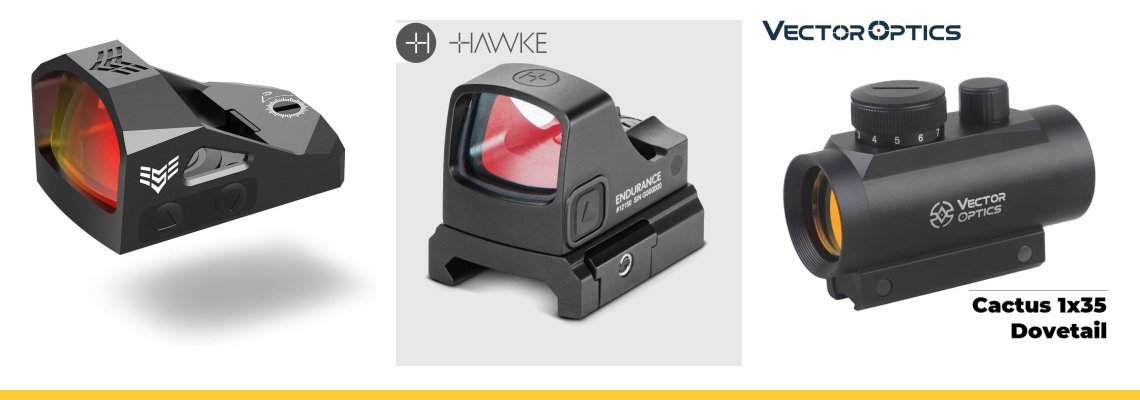
A red dot sight is the fastest way to put an aiming point on a target. You don't have to find the right eye relief, dial magnification or line up front and rear sights. You keep both eyes open, put the dot where you want the shot to go and press.
"Red dot" is a loose label, though. It covers sealed tube sights, matchbox-sized open reflex sights, prism sights with etched reticles, and even lasers sold under the same name.
This guide covers how red dots work, how reflex, tube, prism and holographic sights differ, which dot size suits which job, and when a magnified scope is the better choice. It ends with mounting, zeroing and common questions.
In This Guide
- How a red dot works
- Tube vs open reflex, prism, holographic and laser
- Dot sizes: 2 MOA, 3 MOA, 6 MOA and circle-dot
- Red vs green, brightness and night-vision settings
- Battery life, shake-awake and auto-off
- Mounting: rails, co-witness and pistol footprints
- Red dot vs scope, plus magnifiers
- Zeroing step by step, checklist and FAQs
How a Red Dot Sight Works
A small LED shines forward onto a lens with a reflective coating. The coating reflects the LED's narrow colour back to your eye and lets most other light pass through. The lens is curved so the reflected light comes out nearly parallel. As a result, the dot looks like it is floating out on the target, not sitting on the glass.
That gives two big advantages:
- Unlimited eye relief. You can hold the sight close or far away. Sights like the Bushnell Trophy TRS-25 and the MECANIK MO1 micro reflex sight both list unlimited eye relief.
- One focal plane. You focus on the target and the dot appears on it.
Reflex Sight Types: Tube, Open, Prism and Holographic
Tube (enclosed) red dots
A tube dot looks like a short scope, with glass at both ends sealing the LED inside. Rain and dust cannot block the emitter, which makes tubes a robust choice for rifles, shotguns and air rifles. The Vector Optics Panther 1x34 is a full-metal tactical tube with a 34mm objective. It comes with a 21mm one-piece Weaver mount, flip-up caps and a sunshade. The Vector Optics Cactus 1x35 is lighter, at 160 g with fittings. The TRS-25 is a compact 1x20 mm closed reflex design.
Open reflex (micro) sights
An open reflex sight is a single lens standing up like a small window, with the LED exposed behind it. These sights are tiny, light and low, so they dominate on pistols. The trade-off is that mud or rain can land on the emitter and block the dot. The Swampfox Justice 1x27 has a wide 27mm window for fast pickup.

Prism sights
A prism sight uses a glass prism with the reticle etched into it and lit from behind. Since the reticle is etched, you can still see it as a black outline if the battery dies. According to its maker, the Swampfox Raider 1x20 Micro Prism can also suit shooters who see a starburst instead of a clean dot because of astigmatism. Prisms also come magnified. The Swampfox Trihawk 3x30 prism scope and the TRUGLO Prism PR3 3x32 both give fixed 3x magnification. Prisms have fixed eye relief, unlike a true dot.
Holographic sights
Holographic sights use a laser and a recorded holographic image instead of a reflected LED. They are known for sharp, complex reticles. They are often heavier and tend to use more battery than LED dots.
Lasers are not red dots
Some "red dot" listings are actually lasers that put a beam on the target. The Gamo 650nm red laser sight, for example, is a Class 3R laser. Lasers fade in bright sun and need care: never point one at people, vehicles or reflective surfaces, and never look into the beam.
| Type | Reticle | Strengths | Watch out for | Best for |
|---|---|---|---|---|
| Tube red dot | Projected LED dot | Sealed emitter, durable, rail-friendly | Bulkier than micro sights | Rifles, shotguns, air rifles |
| Open reflex | LED dot or circle-dot | Very small, light, wide view | Exposed emitter can be blocked | Pistols, shotguns, light carbines |
| Prism (1x/3x) | Etched, illuminated | Works without battery, magnified options | Fixed eye relief, heavier | Carbines, medium range |
| Holographic | Holographic image | Sharp complex reticles | Weight, battery use | Fast close-range rifle work |
| Laser | Beam on target | Aim without shouldering | Weak in daylight, safety risk | Short range, low light |
Dot Size: 2 MOA, 3 MOA, 6 MOA and Circle-Dot
Dot size is measured in MOA (minute of angle). One MOA covers roughly 1 inch at 100 yards. A 3 MOA dot therefore covers about 3 inches at 100 yards and about 1.5 inches at 50 yards. A smaller dot hides less of the target. A bigger dot is faster for your eye to find.
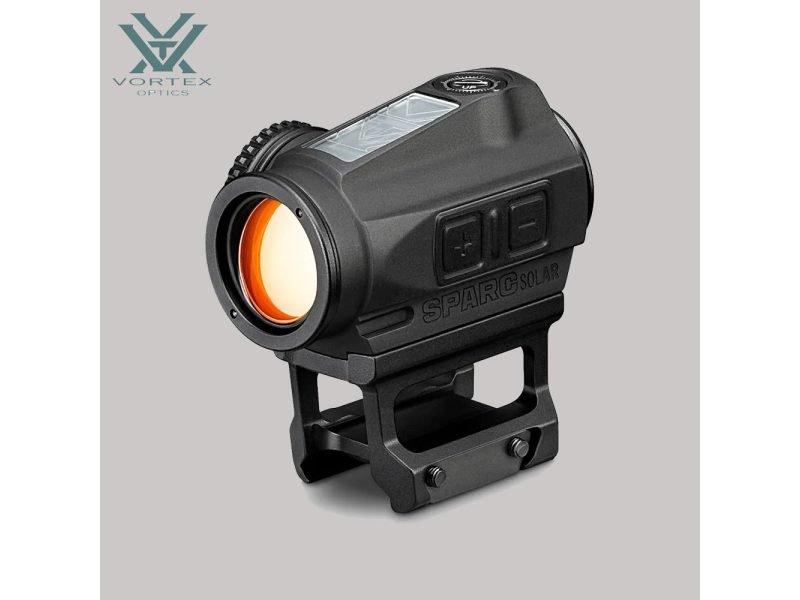
- 2 MOA (precision): best for small targets. The Vortex SPARC Solar uses a daylight-bright 2 MOA red dot.
- 3 MOA (all-rounder): the safest default. It is precise enough for rimfire and airgun distances and still quick on a pistol. The TRS-25, Panther, MO1, Frenzy-S and Justice all use 3 MOA.
- 5-6 MOA (speed): easiest to find in a quick draw or shotgun swing. The Vortex Viper red dot has a 6 MOA dot and the Cactus has 5 MOA. At distance, a dot this size can cover a small target.
- Circle-dot: a large ring that catches your eye fast, with a small centre dot for precision. It is excellent on shotguns and moving targets. The Hawke Endurance reflex sight switches between a 3 MOA dot, a 30 MOA circle and circle plus dot. The Olight Osight C offers a 3 MOA dot and a 32 MOA circle.

Red vs Green, Brightness and Night-Vision Settings
Red vs green: both work. Many shooters find green stands out better in bright sun and against dry, brown terrain, while others find red crisper at low brightness. The Panther offers both in one sight.
Brightness: set the dot just bright enough to see clearly. Too bright and it blooms into a blob that hides the target. Look for a good spread of settings: the TRS-25 has 11, the MECANIK MO2 has 10 manual levels and the US Optics TSR-1X has 12. The MO1 and Frenzy-S AUT adjust automatically with a light sensor.
Night-vision (NV) settings are extra-dim levels for use behind night-vision devices. The MO2 has 2 NVG settings. The SPARC Solar, Vortex Defender-CCW and Riton X3 Tactix sights have NV-compatible low levels. The TSR-1X has 3.
Battery Life, Shake-Awake and Auto-Off
Battery runtime depends heavily on brightness. Treat the manufacturer's figures as a guide.
- MECANIK MO1: CR2032, rated 60,000 hours, with motion-sensor shake-awake and auto-off.
- MECANIK MO2: 40,000 hours at the lowest setting, but about 3,000 hours at middle brightness.
- Bushnell TRS-25: up to 5,000 hours. It has no auto shut-off, so switch it off after use.
- Vortex SPARC Solar: solar powered, switching to battery automatically, with up to 150,000 hours quoted.
Shake-awake (motion activation) turns the dot off when the sight sits still and back on as soon as it moves. Swampfox's Shake N' Wake powers down after 225 seconds of inactivity, and Hawke's A.I.M. goes to standby after 5 minutes. A plain auto-off timer works differently: it switches the sight off after a fixed time, such as 4 hours on the TRUGLO IGNiTE. A top- or side-loading battery, as on the Swampfox Justice or Osight C, lets you change cells without removing the sight, so you keep your zero.
Mounting: Rails, Co-Witness and Pistol Footprints
Rifles, shotguns and a red dot sight for airgun use
Most rifle-style dots clamp to a Picatinny (MIL-STD-1913) or Weaver rail. Many air rifles and rimfires use an 11mm dovetail instead. That is why the Cactus 1x35, which ships with an 11mm dovetail mount, is such an easy fit on air rifles. If the rail and the base don't match, you need an adapter. See our scope mounts and accessories.
Mount height and co-witness
Co-witness means your iron sights line up through the dot window. An absolute co-witness centres the irons in the window. A lower-1/3 co-witness puts them in the bottom third, so the view is less cluttered. For T1/T2/H1-pattern dots, the Elevated Technology Slide height-adjustable mount lets you set the exact height.
Pistol footprints
A footprint is the screw and recoil-boss pattern under the sight. It has to match the cut on your slide, or you need an adapter plate.
- RMR: Swampfox Justice and Kingslayer, Riton X3 Tactix PRD.
- Shield RMSc: MECANIK MO1, Riton X3 Tactix MPRD, Hawke Endurance.
- MAG (RMSc compatible): Vector Optics Frenzy-S.
- Viper footprint: US Optics DRS 2.0.
- 407c/507c: Olight Osight C.
Adapter plates such as the Ohhunt D2-DB plate for Glock 17/19 MOS and Holosun 509T bridge mismatches.

Are Red Dots Really Parallax-Free?
Parallax is the dot appearing to shift on the target when you move your head. "Parallax free" is close to true, but not completely: Vortex itself notes that all red dot and holographic sights show a small amount. Makers set a distance: the Frenzy-S is set at 25 yards (under 2 MOA), and the TRS-25 lists a 50-yard minimum parallax distance. At typical distances it rarely matters; keep the dot roughly centred anyway.
Red Dot vs Scope for Hunting, Airguns and Close Range
It comes down to distance and target size.
- Close range and moving targets: the dot wins. You keep both eyes open, stay aware of your surroundings and can track a flushing bird or running animal.
- Airguns: a dot is great for plinking, training new shooters and short-range pest control. For precise shots at small quarry, magnification usually serves better, because a pellet leaves little margin for error.
- Longer-range hunting: use a magnified scope. It lets you clearly identify the target and aim at a precise point, which is an ethical must. For something in between, a low-power variable like the Vector Optics Mustang 1.5-4x30 or a 3x prism keeps things quick.
Magnifiers are a separate small optic, often 3x, that sits behind a red dot on a flip-to-side mount. You swing it in for a longer shot and out for close work. Keep in mind that the magnifier enlarges the dot along with the target. For magnification, objective size and reticles, see our rifle scope buying guide for airguns in Pakistan.

How to Zero a Red Dot (Step by Step)
Zero only at a proper range with a safe backstop. Treat every gun as loaded and keep the muzzle pointed in a safe direction.
- Mount it solidly. Tighten the clamp or footprint screws to the maker's guidance.
- Choose a zero distance. Many shooters use 10-25 metres for airguns and pistols and longer distances for centrefire rifles.
- Set the brightness so the dot looks crisp, not blooming.
- Fire a rested group of three to five shots at a clear aiming mark.
- Measure the offset and convert it to MOA.
- Adjust windage and elevation in the direction marked on the turrets. Many sights use 1 MOA clicks.
- Confirm with a second group, then lock the turrets if your sight has locks.
- Recheck your zero after any battery change that meant removing the sight.
Quick Buying Checklist
- Does it fit? Check the rail (Picatinny, Weaver, 11mm dovetail) or pistol footprint.
- Do you want a tube or an open reflex sight? Base it on how wet and dusty your shooting gets.
- Pick a dot size: 2 MOA for precision, 3 MOA as an all-rounder, 6 MOA or circle-dot for speed.
- Decide on red or green, and check there are enough brightness levels for bright summer sun.
- Check the battery type, rated life, auto-off or shake-awake, and how you reach the battery.
When comparing red dot sight price in Pakistan listings, weigh these features, not just the brand. Browse our red dot sights, reflex sights and wider optics and scopes. To handle a few sights in person, visit Just Hunters in Gulberg, Lahore. You can also order online with cash on delivery anywhere in Pakistan.
Responsible Use
A better optic does not change the rules. Provincial wildlife departments regulate hunting in Pakistan, including licences, open seasons, bag limits and protected species, so check with yours before every trip. See our hunting season in Pakistan article. Still choosing a gun? See the best airguns for hunting in Pakistan or browse air rifles.
Frequently Asked Questions
What is the difference between a red dot and a reflex sight?
A reflex sight is a type of red dot. Both reflect an LED dot off a coated lens so it appears on the target. "Reflex sight" usually means an open design with a single exposed lens, as on most pistol micro dots. "Red dot" is the broader term and also covers enclosed tube sights, which seal the emitter inside a housing for better protection against rain and dust.
Which MOA red dot is best for an air rifle?
For most air rifles, a 2 or 3 MOA dot gives the best balance. A small dot hides less of a small target at typical airgun distances, and 3 MOA is still quick to pick up. Bigger 5 or 6 MOA dots are faster but can cover small targets completely. Also check the mounting rail, because many air rifles use an 11mm dovetail rather than Picatinny.
Is a red dot or a scope better for hunting?
It depends on distance. A red dot is better for close, fast shots and moving game, because both eyes stay open and you see the whole scene. A magnified scope is better for longer or more precise shots, because it lets you clearly identify the animal and aim at a small point. Many hunters use a low-power variable or a dot with a magnifier as a compromise.
Should I choose a red or green dot?
Both work well, so your own eyes matter most. Many shooters find green stands out better in bright daylight and against dry, brown backgrounds. Others find red looks sharper at low brightness settings. If you have colour vision deficiency, or if you can visit a shop, compare both colours in similar light before you decide which one to buy.
How long does a red dot battery last?
It depends heavily on the brightness setting. Ratings range from a few thousand hours to tens of thousands at low settings. The MECANIK MO2, for example, is rated 40,000 hours at its lowest setting but about 3,000 hours at middle brightness. Shake-awake and auto-off features stretch battery life a lot, and top-loading batteries let you change cells without losing zero.
Why does my red dot look like a starburst?
The usual causes are brightness set too high and astigmatism in the shooter's eye. First, turn the brightness down until the dot is just clearly visible. If it still looks like a starburst or comma, try a prism sight with an etched reticle, such as the Swampfox Raider, which is designed partly with this in mind. An eye test and corrective lenses can also help a lot.
Conclusion
Choosing the right red dot sight comes down to four things: the format (tube, open reflex or prism), a dot size that suits your targets, power features you will actually use, and a mount or footprint that fits your gun. Choose magnification when distance and precision matter more than speed. To compare sights side by side, the Just Hunters team in Lahore is happy to help in store or online.