
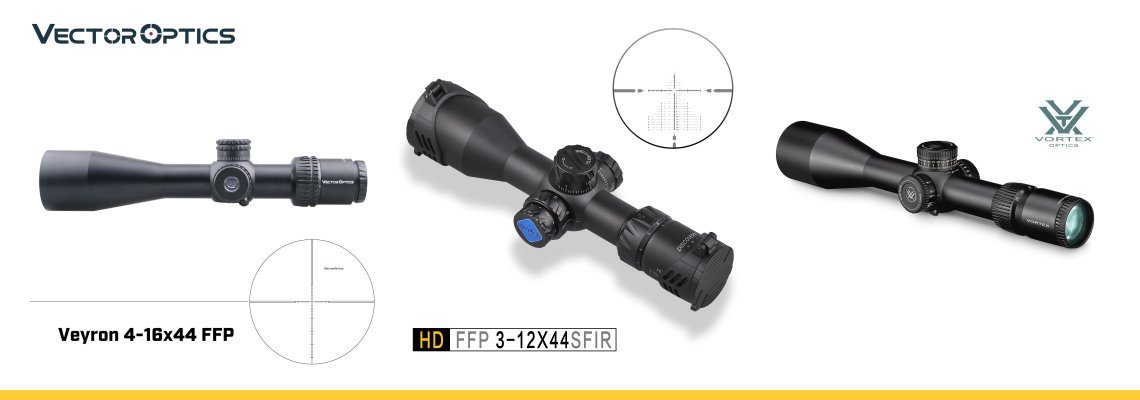
A good rifle scope can make an average air rifle shoot like a much better one, and a poor choice can make even an expensive PCP feel frustrating. Most scope problems we see are not about cheap glass. They come from the wrong magnification, a reticle that does not suit the shooter, parallax that was never set, or rings that put the scope at the wrong height and eye relief.
This guide explains every important scope specification in plain language, so you can read a name like "4-16x44 SF FFP" and know exactly what it means for your airgun or rifle.
You can browse the full range of rifle and airgun scopes online, or compare them side by side at the Just Hunters shop in Gulberg, Lahore, where you can look through a scope before you decide.
In this guide
- Reading scope numbers: magnification and objective lens
- First focal plane (FFP) vs second focal plane (SFP)
- Parallax, side focus and adjustable objective
- Reticle types, including illuminated reticles
- Turrets, zeroing and MOA vs MRAD clicks
- Tube diameter, rings and mounts
- Eye relief and spring-piston recoil
- Red dot and reflex sights for close range
- Matching a scope to your shooting, plus a checklist and FAQ
Reading the Numbers: Magnification and Objective Lens
A scope called "3-9x40" has variable magnification from 3x to 9x and a 40 mm objective (front) lens. A fixed scope such as "4x32" has one magnification only.
Which magnification range suits what?
- 3-9x: the classic all-rounder. Ideal for air rifle hunting and plinking from about 10 to 50 metres.
- 3-12x / 4-16x: a sweet spot for PCP hunting and target practice out to 60-80 metres.
- 6-24x: for benchrest, field target and longer-range work from a rest.
- 5-25x and above: long-range rifle shooting where precise holdovers at distance matter.
More magnification is not always better: it narrows the field of view and magnifies every wobble.
Objective lens size
A bigger objective gathers more light, which helps at dawn and dusk. The useful number is the exit pupil: objective diameter divided by magnification. A 40 mm lens at 10x gives a 4 mm exit pupil, which is comfortable in daylight. In low light, turning the magnification down gives a brighter picture.
The trade-off is size. A 50 mm or 56 mm objective is heavier and needs higher rings to clear the barrel. For most airgun use, a 40-44 mm objective is a very practical balance. The T-Eagle SR 3-9x50 WA HK is a good example of a light, simple 3-9x scope with a larger 50 mm objective on a standard 1 inch tube.
First Focal Plane (FFP) vs Second Focal Plane (SFP)
This is simply about where the reticle sits inside the scope.
- SFP (second focal plane): the reticle stays the same size as you zoom. It always looks thin and clear. However, the hash marks or mil-dots only measure correctly at one magnification (often the highest, but check the manual).
- FFP (first focal plane): the reticle grows and shrinks with the image. Holdover and range-estimation marks are correct at every magnification. At low power the reticle can look very fine; at high power it looks thicker.
If you mostly shoot at one zoom setting and use a simple crosshair, SFP is perfectly fine and usually more affordable. If you use holdover marks at different ranges and change magnification often, FFP saves you mental arithmetic in the field.
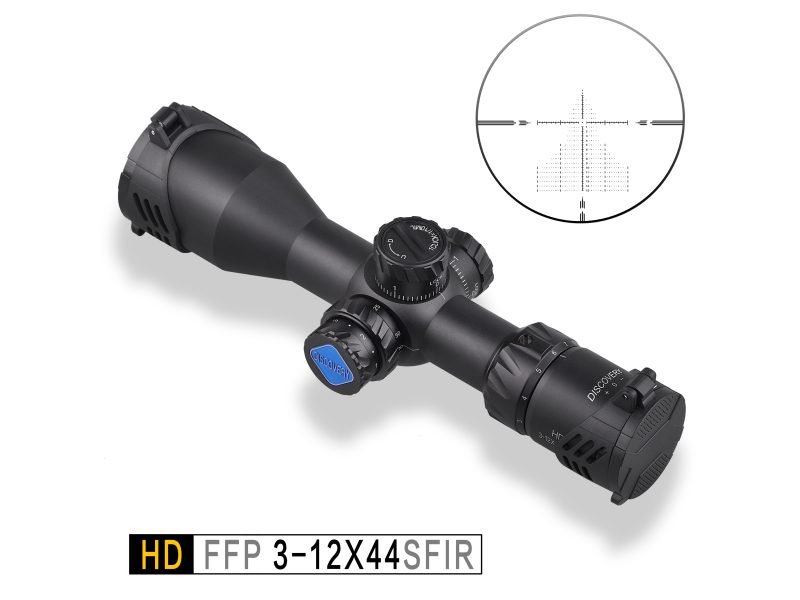
The Discovery Optics HD 3-12X44 SFIR FFP Compact is a good example of a hunting-sized FFP scope: 3-12x, 44 mm objective, 30 mm tube, side parallax from 10 yards, red/green illumination and 1/10 MIL clicks in a 24.5 cm body.
| Feature | First Focal Plane (FFP) | Second Focal Plane (SFP) |
|---|---|---|
| Reticle size when zooming | Changes with magnification | Stays the same |
| Holdover marks accurate | At every magnification | At one set magnification only |
| Reticle at low power | Can look very thin | Always easy to see |
| Best for | Holdover shooting, long range, changing distances | Simple crosshair hunting, plinking, budget builds |
Parallax: Side Focus and Adjustable Objective
Parallax is when the reticle seems to move against the target as you move your eye slightly behind the scope. The result is a point of impact that shifts with your head position.
Many rifle scopes are set parallax-free at around 100 yards, which is far beyond most airgun shots. At typical airgun distances of 15-50 metres this matters a lot, which is why adjustable parallax is one of the most valuable features on an airgun scope. There are two common types:
- AO (adjustable objective): you turn a ring on the front of the scope.
- SF (side focus): a wheel on the left turret. Easier to reach from the shooting position.
To set parallax, focus the eyepiece on the reticle first, then turn the AO or side wheel until the target is sharp and the reticle does not move when you shift your head slightly. Also check the minimum focus distance: 10 yards is far more useful for airguns than 30 yards.
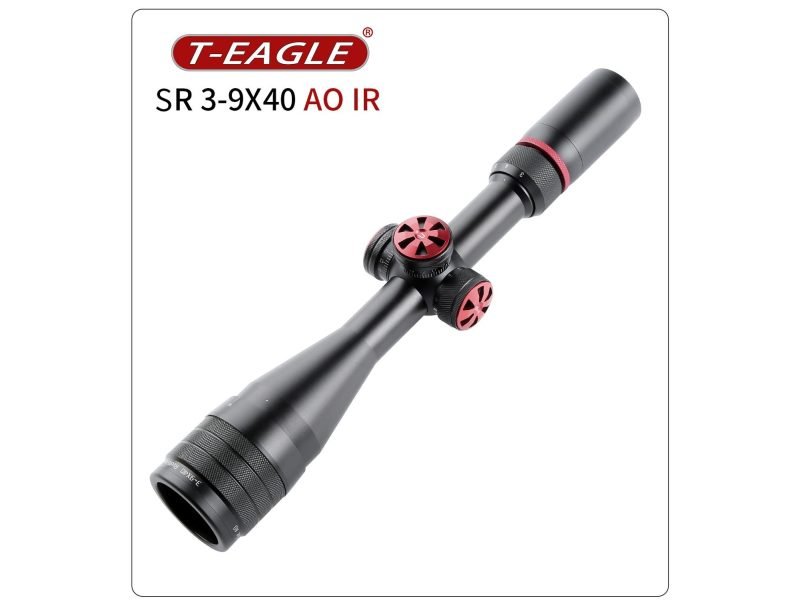
The T-Eagle SR 3-9x40 AO IR is a compact 32 cm SFP scope with an adjustable objective and illuminated reticle, while the T-Eagle R 4.5-18x44 SF moves the parallax control to a side focus wheel and uses a mil-dot wire reticle.
Reticle Types
Duplex
Thick outer posts that thin towards the centre. Fast and uncluttered, but with no holdover marks.
Mil-dot
Dots spaced one milliradian apart on the crosshair. Popular on airgun scopes for holding over or under for pellet drop.
MOA and MIL hash reticles
Hash or "tree" reticles have fine MOA or MIL marks. The golden rule: choose a reticle that matches your turrets. A MIL reticle with MIL turrets (or MOA with MOA) lets you read a correction on the reticle and dial exactly that number. The Vortex Venom 5-25x56 FFP pairs its FFP EBR-7C MOA reticle with 1/4 MOA turrets, and the Kestrel Optics HD 6-24X50 SF FFP pairs its MAT-1 MIL-dot reticle with 1/10 mil turrets.
BDC reticles
Bullet drop compensator reticles have aiming points for set distances. The Vortex Crossfire II 4-12x50 AO uses the Dead-Hold BDC reticle on a 1 inch tube with capped 1/4 MOA turrets and an adjustable objective. BDC marks are designed around typical loads, so always confirm them with your own pellets or ammunition on paper.
Illuminated reticles
Marked "IR" in scope names, illumination lights up part of the reticle for low light or dark backgrounds such as shooting into bushes. Use the lowest visible brightness so it does not flare, and carry a spare battery.
Turrets and Zeroing: MOA vs MRAD
The elevation (top) and windage (side) turrets move your point of impact. Each click moves it by a fixed angle:
- 1/4 MOA click: about 7 mm at 100 metres (about 0.26 inch at 100 yards).
- 1/8 MOA click: half of that, for very fine adjustment.
- 0.1 MRAD (1/10 MIL) click: 1 cm at 100 metres, or 5 mm at 50 metres. Easy to work out in metric.
Neither system is more accurate; MRAD is just easier if you think in centimetres and metres.
Capped turrets are set once at zero and covered, which suits hunters who use holdover. Exposed tactical turrets are for shooters who dial for distance. Features such as zero reset and zero stop let you return to your zero quickly after dialling. The Discovery HD 5-30X56 SFIR FFP ZEROSTOP GEN2 offers 0.1 mrad push-lock turrets with zero reset, zero stop and a revolution indicator.
Quick zeroing method
- Mount the scope level and set eye relief before tightening the rings fully.
- Focus the eyepiece on the reticle and set parallax for your zero distance.
- Shoot a group of 3-5 shots at your zero distance (many airgun hunters use 25-30 metres) from a steady rest.
- Convert the distance from group centre to aim point into clicks, adjust and repeat.
Tube Diameter, Rings and Mounts
Scope tubes are usually 1 inch (25.4 mm), 30 mm or 34 mm. A larger tube mainly gives more internal adjustment room for long range; it does not automatically mean a brighter image. Rings must match the tube exactly.
- 1 inch: light and common on budget and mid-range scopes.
- 30 mm: very popular for modern hunting and PCP scopes.
- 34 mm: long-range scopes with large elevation travel, such as the Venom and Discovery HD 5-30 mentioned above.
Dovetail 11 mm vs Picatinny/Weaver
Most air rifles and many rimfires have an 11 mm dovetail groove. Centrefire rifles and many PCPs use Picatinny or Weaver rails (about 21 mm wide with cross slots). Dovetail and Picatinny rings are not interchangeable, so check your rail before you buy. You will find both types in our scope mounts and accessories section.
One-piece vs two-piece mounts
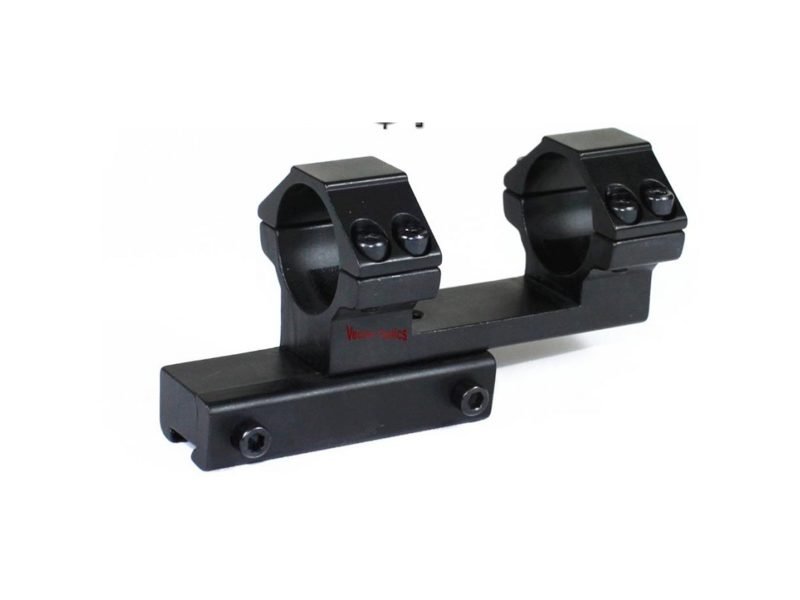
Two-piece rings are light and flexible for positioning, like the Discovery Optics Dovetail 25.4mm High Profile 2 PC Mounts for 1 inch scopes on 11 mm rails. One-piece mounts keep both rings aligned and resist movement better on recoiling guns. The Vector Optics 30mm One Piece Long 11mm Dovetail Mount uses a 120 mm base with an anti-shock pin for 30 mm scopes.
Scope height
Choose the lowest rings that let the objective clear the barrel with a comfortable cheek weld. Objectives of 50 mm and above usually need high rings, but mounting too high makes a steady cheek position harder.
Eye Relief and Spring-Piston Recoil
Eye relief is the distance from your eye to the eyepiece where you see a full, clear picture, usually around 3-4 inches. Set it in your normal shooting position: slide the scope until the dark ring around the image disappears. On firearms, enough eye relief keeps the scope off your eyebrow under recoil.
Spring-piston and gas-ram airguns are a special case. Their piston slams forward and then stops sharply, creating a two-way jolt that can damage scopes not built for it and makes scopes creep in their rings. For a spring-piston airgun:
- Choose a scope whose maker lists it as suitable for spring airguns.
- Use a one-piece mount with a recoil stop pin that sits in the hole or slot on your rail.
- Tighten ring screws evenly in a cross pattern.
Break-barrels often have short scope grooves, which makes correct eye relief difficult. An extended mount like the Vector Optics SCOP-11 1 inch one-piece extended dovetail mount lets you position the scope further forward and has an anti-shock pin for hard-recoiling air guns. PCP rifles, by contrast, have very little recoil, so almost any good scope works on PCP air rifles.
Red Dot and Reflex Sights for Close Range
A red dot sight has no magnification (1x) and puts an illuminated dot on the target. Both eyes can stay open, and most designs have unlimited eye relief, so target pickup is very fast. They suit close-range plinking, moving targets and beginners.
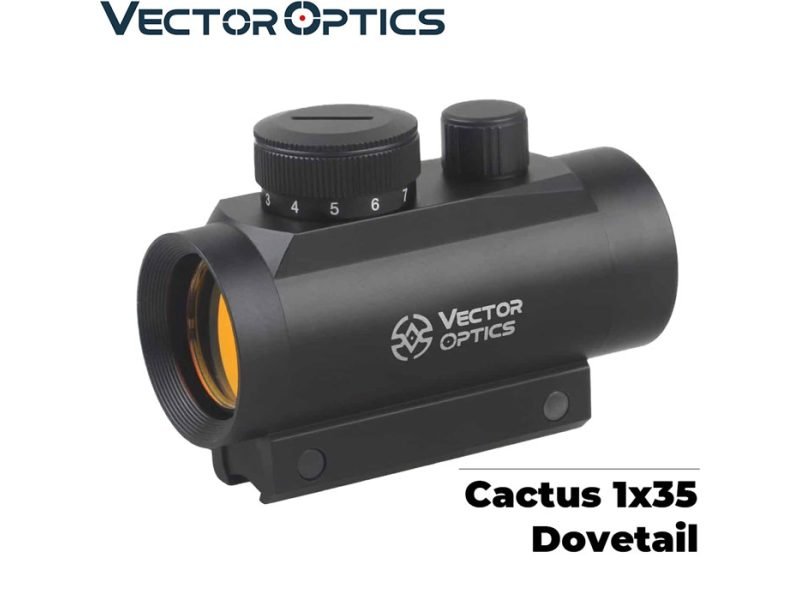
The limit is precision at distance. For air rifles, the Vector Optics Cactus 1x35 red dot comes with an 11 mm dovetail mount, a 5 MOA dot with 7 brightness levels and a wide 35 mm window. See more options in our red dot sights collection.
Matching the Scope to Your Shooting
Pest control and bird hunting
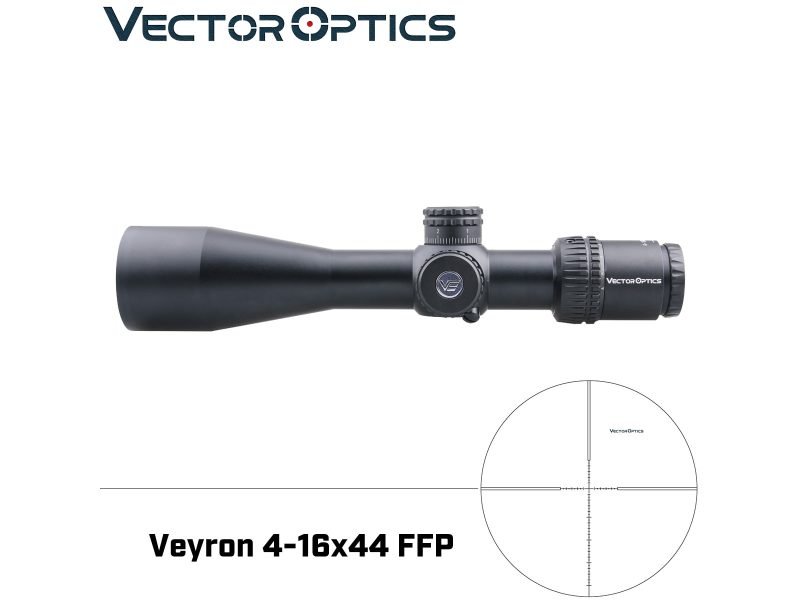
Shots are usually 15-50 metres, often in trees or fields with changing light. A 3-12x or 4-16x with side focus that works close, a mil-dot or hash reticle for holdover, and optional illumination work well. The ultra-compact Vector Optics Veyron 4-16x44 SF FFP is about 270 mm long, focuses from 10 yards and has 1/10 MIL clicks, which suits compact PCPs. For more on choosing the rifle itself, read our guide to the best airguns for hunting in Pakistan.
General hunting with air rifles and rimfires
A 3-9x, 3-12x or 4-14x with a 1 inch or 30 mm tube covers most needs. The BSA TMD 4-14x44 SF FFP has a one-piece 30 mm tube, side parallax from 10 yards to infinity and a compact 330 mm length, making it a flexible option for air rifles and rimfires used for hunting and target work.
Long range and precision target
Look for 5-25x or 6-24x, FFP, matching MOA or MIL turrets with plenty of elevation travel, and a reliable zero stop or zero reset. A 34 mm tube is common at this level. A bubble level helps avoid cant.
| Use | Magnification | Key features | Sight type |
|---|---|---|---|
| Plinking, beginners | 1x to 3-9x | Simple reticle, light weight | Red dot or 3-9x40 |
| Pest control (airgun) | 3-12x to 4-16x | Close side focus, holdover reticle | SF scope, FFP or SFP |
| Spring-piston airgun | 3-9x to 4-12x | Spring-rated scope, stop-pin mount | Compact scope |
| General rifle hunting | 3-9x to 4-14x | Good low-light glass, duplex or BDC | 1 inch or 30 mm scope |
| Long range / target | 5-25x, 6-24x and above | FFP, matching turrets, zero stop | 30 mm or 34 mm scope |
Practical Scope Buying Checklist
- What distance will I actually shoot most? Choose magnification for that, not for the maximum.
- Does the scope focus close enough for my range (10 yards is very useful for airguns)?
- FFP or SFP: will I use holdover marks at different magnifications?
- Do the reticle and turrets use the same unit (MOA/MOA or MIL/MIL)?
- Tube diameter: 1 inch, 30 mm or 34 mm, and do my rings match?
- Rail type on my rifle: 11 mm dovetail or Picatinny/Weaver?
- Is it a spring-piston gun? If yes, choose a spring-rated scope and a stop-pin mount.
Responsible use: treat every airgun and firearm as loaded, never point it at anything you do not intend to shoot, always check what is behind your target, and follow local laws and wildlife department rules on licences, seasons and protected species.
Frequently Asked Questions
What is the best scope magnification for an air rifle?
For most airgun hunting and plinking in Pakistan, 3-9x or 4-12x is ideal. Choose 4-16x or 6-24x if you do a lot of benchrest or target shooting from a rest at longer distances.
Can I use a firearm scope on a spring-piston airgun?
Not always. Choose a scope its maker rates for spring airguns, with a stop-pin mount. PCP air rifles are much gentler on scopes.
Is FFP better than SFP?
Neither is better for everyone. FFP keeps holdover marks accurate at every zoom level, which suits long range and changing distances. SFP keeps the reticle the same size and is simpler and usually more affordable for crosshair hunting.
Do I really need adjustable parallax on an airgun scope?
It is strongly recommended. Airgun shots are usually well inside the distance many fixed-parallax scopes are set for, so side focus or AO gives you a sharp image and a more consistent point of impact.
Should I choose MOA or MRAD?
Both work well. MRAD is easy with metric distances (0.1 mil is 1 cm at 100 metres), while MOA is common on US-market scopes. Just match reticle and turrets.
Is a red dot good for hunting?
For close shots and fast-moving targets it can be excellent. For small quarry at longer range, a magnified scope gives far better precision.
The best rifle scope is the one that fits your rifle, your rail, your distances and your way of shooting. If you are new to airguns, our airgun types and buying guide is a good next read. Visit Just Hunters in Gulberg, Lahore to compare scopes in person, or order online with cash on delivery anywhere in Pakistan.