
A well-kept airgun shoots tighter groups, lasts longer and holds its value. A neglected one rusts, loses power and starts throwing fliers. The surprise for many shooters is that airguns usually need less cleaning than firearms, not more. Over-cleaning, too much oil and the wrong lubricant in the wrong place damage more airguns than dirt ever does. This guide covers what to clean, when, and what never to do in Pakistan's humidity and dust.
In this guide
- Why and how often to clean an airgun barrel
- Cleaning tools: rods, pull-throughs, patches, jags, brushes and muzzle guards
- Safe step-by-step barrel cleaning procedure
- Oiling: what to lubricate and what to leave dry
- Care for spring-piston, PCP and CO2 airguns
- Rust prevention, storage and scope care in Pakistan's climate
- When to get a professional service
- Maintenance schedule, checklist and FAQ
Why and How Often Should You Clean an Airgun?
Every lead pellet leaves a tiny amount of lead behind in the rifling. This build-up, called leading, collects with dust, old lubricant from the pellets and moisture. Over time groups can open up. Unlike a firearm, an airgun has no corrosive powder residue, so you clean for accuracy and rust prevention.
Clean when there is a reason
- Accuracy drops with a pellet and range that used to group well, and your scope mounts and technique are not the cause.
- After a large number of shots. Many shooters clean after several hundred to a thousand or so pellets, but the right interval depends on your barrel and pellets. Let your groups tell you.
- When the gun is new, to remove factory oil, unless the maker advises against it.
Avoid over-cleaning
Many precision barrels shoot best when slightly "seasoned" with lead. Scrubbing after every session risks wearing the crown and bore. A sensible rule: clean the bore when accuracy tells you to, but wipe and protect the outside of the gun after every session.
Cleaning Tools You Need
A few quality tools in the correct calibre are enough. You can browse everything below in our gun cleaning kits category.
One-piece cleaning rods
A one-piece rod has no joints that can flex or scrape the bore, so it gives a smooth, even stroke. The Rotchi one-piece carbon fibre cleaning rod comes in 5mm and 7mm diameters with a 36-inch working length and a rotating aluminium handle, so brushes and jags follow the rifling instead of fighting it. Always check that the rod diameter is clearly smaller than your bore and that it is long enough for your barrel.
Pull-throughs and bore snakes
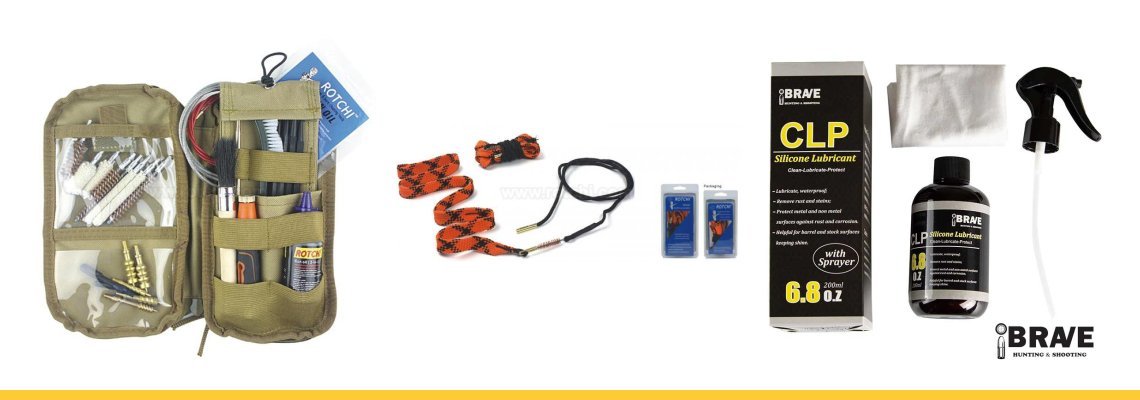
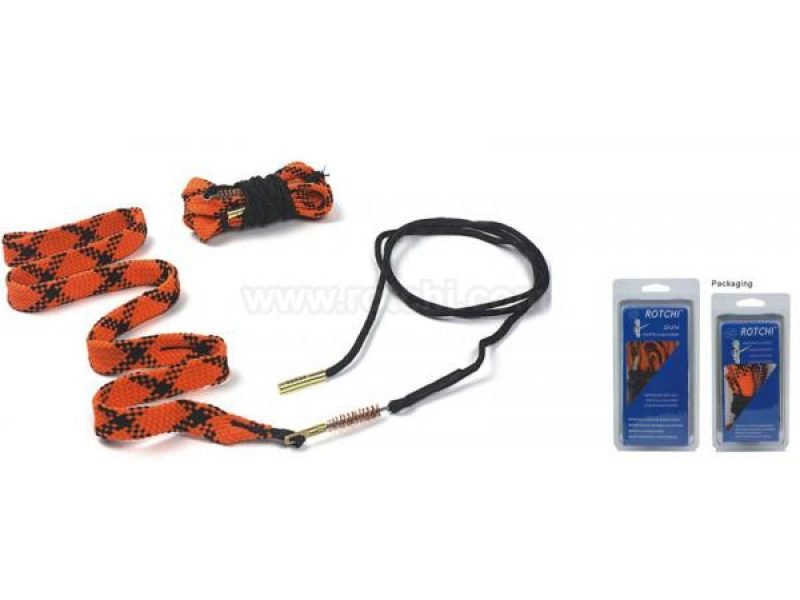
Pull-through cables and rope-style bore snakes are light, fast and easy to carry in a range bag. They can be pulled from breech to muzzle without touching the crown. The Rotchi bore snake for .22/.223/5.56 is listed for both rifles and airguns and combines a bronze brush with a cleaning rope for a scrub-and-wipe in one pull. The Rotchi .22 rifle bore snake is aimed at .22 rimfire and .22 air rifle owners who want a quick routine after each session.
All-in-one cleaning kits
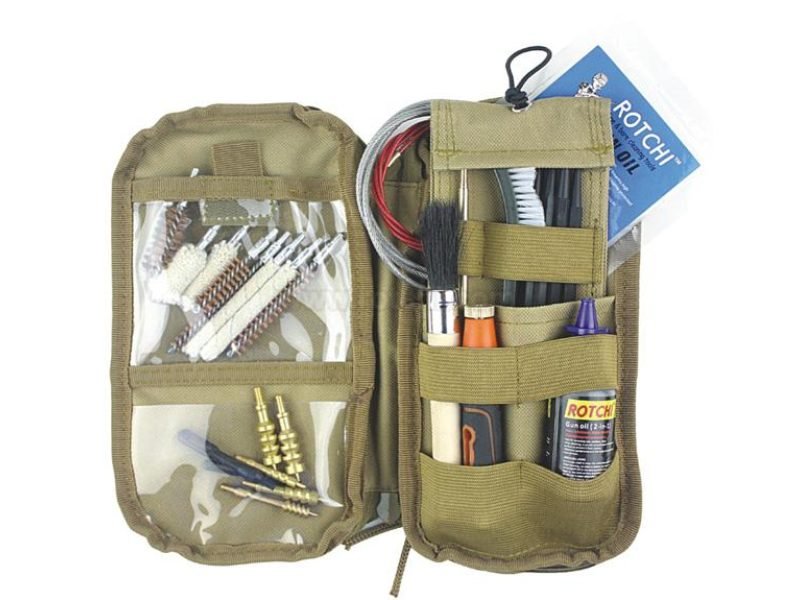
The Rotchi Universal Tactical Gun Cleaning Kit covers .177 and .22 airguns as well as .30 and common handgun calibres up to .44/.45. It includes two flexible pull-through cables (one for .177, one for .22), brass rods, bronze brushes, cotton mops, brass jags, patch holders, an oil bottle and cleaning patches in a cloth bag. Firearm owners can use it for pistols too.
Patches and jags
Patches do most of the real cleaning. The Rotchi cotton cleaning patches for .177 to .22 calibre are absorbent 3/4 inch squares in a 500-piece pack, made for air rifles and air pistols used with a rod, jag or patch holder. A patch should fit snugly without being forced.
Brushes: brass, bronze and nylon
Lead fouling is soft, and for most airgun cleaning patches alone are enough. A nylon brush is the gentler choice when you need to loosen deposits. Keep brass or bronze brushes for occasional, stubborn leading, use them with a little solvent, and never use stainless steel wire brushes in an airgun bore. For trigger guards, rails and other tight spots outside the bore, a small set such as the 5-in-1 tactical tube brush cleaning kit reaches places a cloth cannot.
Muzzle guards
The crown at the muzzle is the last thing a pellet touches, and a tiny nick there can ruin accuracy. A muzzle guard or rod guide keeps a rod centred so it cannot rub the crown.
Safe Step-by-Step Barrel Cleaning Procedure
Always read your airgun's manual first. The maker's advice always comes before any general guide.
- Make it safe. Point the muzzle in a safe direction, remove the magazine, check the breech and barrel are empty, and apply the safety. On a PCP or CO2 gun, de-cock it and, if the manual recommends it, remove the CO2 capsule or degas. On a springer, never leave it cocked.
- Set up a clean work area with a mat, good light and the gun held securely. Keep pellets off the bench.
- Work from the breech when you can. On a break-barrel, open the barrel and clean from the breech end towards the muzzle. On many PCPs, removing the magazine gives breech access. If you must clean from the muzzle, use a muzzle guard.
- Keep the muzzle pointing down so solvent and debris run out of the barrel, not back into the action, the transfer port or the compression chamber.
- Use a small amount of cleaner. Lightly moisten a patch. Never pour or spray solvent down the barrel of an airgun. On a springer, excess liquid that reaches the compression chamber can cause dieseling.
- Push or pull in one direction. Go from breech to muzzle, let the patch exit fully, then remove it before pulling the rod back.
- Follow with dry patches until they come out clean or only lightly grey.
- Protect the bore if storing. For short-term use, a dry bore is fine. For long storage in humid weather, a very lightly oiled patch is enough, but run a dry patch through before shooting again.
- Re-check zero with a few fouling shots before hunting.
Oiling: What to Lubricate and What to Leave Alone
What usually benefits from light care
- Exterior metal: a thin protective film against rust, wiped on with a cloth.
- Pivot points and linkages such as the break-barrel pivot, cocking linkage and underlever joints: a drop of suitable oil, wiping away the excess.
- Trigger and moving parts: only if the manual says so and only with the lubricant it specifies.
What NOT to oil
- Never put petroleum oil, gun oil or excess lubricant into a spring-piston compression chamber. Under compression, oil can ignite and "diesel". This causes loud cracks, smoke and erratic power, and can damage the seal and spring. Only use a specialist silicone chamber oil, and only where and in the amount the maker specifies. Many modern springers need none at all.
- Don't oil pellets or the transfer port.
- Don't soak seals and O-rings in general-purpose oil. Some petroleum products can make certain seals swell or degrade.
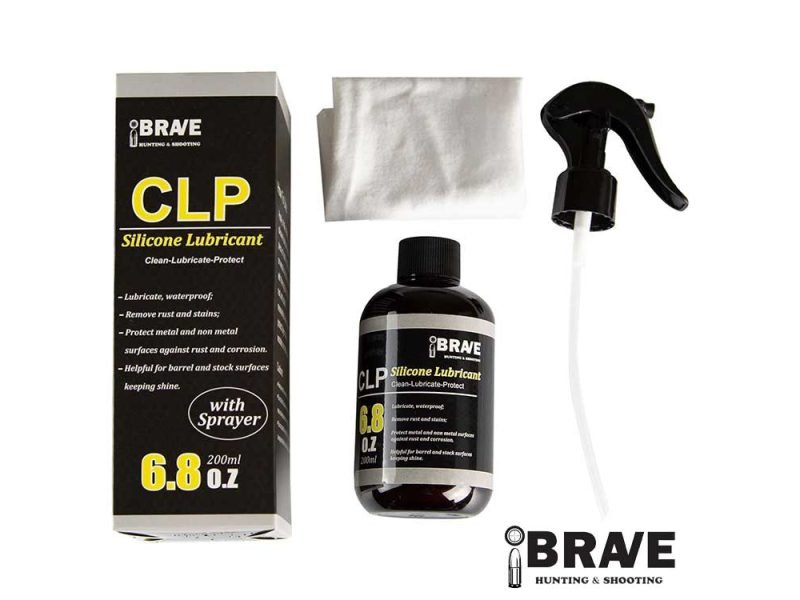
For exterior protection, the iBrave silicone lubricant is listed for protecting metal and non-metal surfaces against stains, corrosion and rust, and for keeping barrel and stock surfaces water-repellent. Put a little on the included cotton rag and wipe the outside of the gun. It is an exterior protectant, so keep it away from the compression chamber. Ballistol is also popular with our customers for exterior care. Whatever you use, check your airgun maker's guidance first. You will find more options in our lubricants and oils section.
Care by Airgun Type
Spring-piston airguns
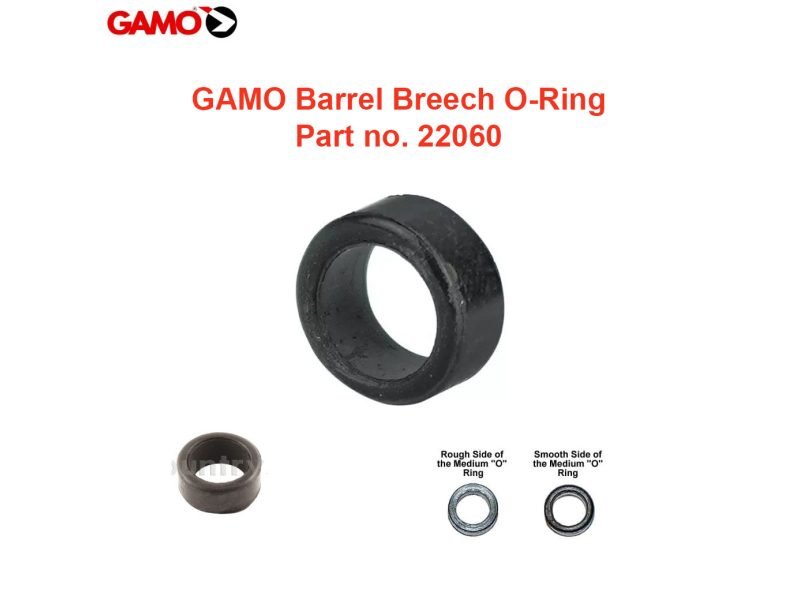
Springers are simple and tough, but the compression chamber, piston seal and breech seal are the heart of the gun. Avoid dry-firing, store the gun uncocked, and check the breech seal on break-barrels for flattening or cracks, since a worn one costs power. For Gamo owners, the Gamo barrel breech O-ring (part 22060) is a small, inexpensive service part listed for most Gamo break-barrels and worth keeping as a spare. Browse more in our airgun parts and accessories category.
PCP air rifles
Pre-charged pneumatic rifles need a different kind of care because they hold high-pressure air.
- Keep the air dry. Moisture from a hand pump or compressor can collect in the cylinder and cause internal corrosion. Use a filter or moisture separator and bleed it as the pump's manual says.
- Never exceed the rated fill pressure printed on the rifle or cylinder, and never fill a cylinder that is damaged, out of test date or showing dents.
- Look after the fill probe O-rings. A thin smear of silicone grease suitable for airgun O-rings keeps them supple and sealing. Don't use petroleum grease unless the maker approves it.
- Keep the fill port dust cap on.
- Watch for leaks. If the gauge drops overnight or you hear hissing, stop and get it checked. Never take apart a pressurised PCP.
Explore models in our PCP air rifles range, or read our airgun types and buying guide for how PCPs differ from springers.
CO2 pistols and rifles
CO2 guns are easy to maintain. If your manual recommends it, put a drop of pellgun or CO2 oil on the tip of each new capsule to keep seals supple. The Crosman 12 gram CO2 cartridge is listed as containing silicone lubricant to help keep seals and internals in good condition. Clean gas matters too: the Umarex 12g CO2 cartridges are tested for cleanliness and fit, since dirty gas can clog valves and wear out O-rings. Never heat or puncture CO2 capsules yourself.
Rust Prevention in Pakistan's Humidity and Dust
Monsoon humidity and summer dust are hard on blued steel, and sweaty fingerprints can start rust spots within days.
- Wipe down after every outing, especially after handling. Remove sweat, dust and moisture first, then apply a thin protective film.
- Dry the gun completely after rain or dew before it goes into a case.
- Clean dust from the action and scope mounts with a soft brush before it works into moving parts.
- Use a muzzle cap during storage and dusty trips. The Rotchi muzzle cap for .22 to .30 calibre is listed for keeping dust, rust and moisture out of the bore.
Storage: Cases, Safes and Moisture Control
Store airguns uncocked, unloaded, and with PCPs at the storage pressure the maker recommends. Don't leave a gun zipped in a case for weeks in humid weather, as cases trap moisture. A lockable cabinet or safe keeps guns away from children. Add a dehumidifier rod or silica gel desiccant packs inside, and dry or replace the desiccant regularly.
For firearm owners putting a gun away for a long time, Hoppe's No. 9 Gun Grease is formulated for protecting idle firearms, lubricating moving parts and guarding against corrosion during storage.
Scope and Optics Cleaning
Lenses scratch easily and their coatings are delicate. Use flip-up caps or covers whenever the scope is not in use. First blow or brush loose dust off; never wipe dry grit across a lens. Then use a lens pen or clean microfibre cloth with lens fluid, in gentle circles from the centre out. Never use your shirt or tissue, and keep gun sprays off the glass. If you are upgrading your optics, see our rifle and airgun scopes.
When to Get a Professional Service
Some jobs are best left to an experienced airgunsmith. Get help if you notice:
- Loss of power or inconsistent velocity on a springer, often a sign of a worn piston seal or tired mainspring.
- Heavy dieseling, smoke or a harsh, twangy shot cycle.
- Air leaks on a PCP, a gauge that drops, or valve problems.
Replacing a mainspring or piston seal means stripping the action under spring tension, so it should be done by someone familiar with airgun servicing. Original parts such as the Diana OEM piston seal (listed for Diana/RWS 34, 48 to 54, 340, 350, 350 Magnum, 56TH and 98K) and the Diana original mainspring for models 31, 34, 35, 36, 38 and 45 help restore a well-used springer. Just Hunters at our Gulberg, Lahore shop can advise you on the right part for your model.
Airgun Maintenance Schedule
| Task | How often | Notes |
|---|---|---|
| Wipe exterior and apply thin protective film | After every session | More often in monsoon season or after sweaty handling |
| Check screws and scope mounts | Every few sessions | Don't over-tighten stock or mount screws |
| Barrel cleaning with patches | When accuracy drops, or after several hundred to around a thousand shots | Clean from the breech where possible |
| Pivot and linkage lubrication | Every few months or as the manual states | One drop, wipe off the excess |
| Inspect breech seal (springers) | Every few months | Replace if flat, cracked or leaking |
| Fill probe O-rings (PCP) | Check at every fill, grease lightly as needed | Silicone grease, never exceed rated fill pressure |
| CO2 capsule tip oil | Each new capsule, if the maker recommends it | One drop only |
| Storage check and desiccant refresh | Monthly, every few weeks in monsoon | Look for rust spots and moisture |
| Professional service | When power drops, leaks or dieseling appear | Seals, springs and valves |
Quick Maintenance Checklist
- Gun unloaded, de-cocked, magazine out, safety on
- Manual checked for maker-specific instructions
- Cleaning from breech to muzzle, muzzle pointing down
- Solvent and oil used in tiny amounts only
- No oil in a springer's compression chamber unless the maker specifies chamber oil
- Exterior wiped and protected
- Muzzle capped, gun stored uncocked with desiccant
- Zero confirmed before the next hunt
Frequently Asked Questions
How often should I clean my airgun barrel?
Only when accuracy drops or after a large number of shots, often several hundred to a thousand or so, depending on the barrel and pellets. Wipe the outside after every session, but avoid scrubbing the bore after every outing.
Can I use normal gun oil inside a spring airgun?
Not in the compression chamber. Petroleum or gun oil there can cause dieseling and damage seals. Use only a specialist silicone chamber oil, and only if your airgun maker specifies it.
Is a bore snake or a cleaning rod better for airguns?
Both work. A bore snake or pull-through is quick, portable and gentle on the crown. A one-piece rod gives more control for a deeper clean.
Should I use a brass or bronze brush in my airgun?
Only occasionally, for stubborn leading. Patches handle most cleaning, and a nylon brush is gentler. Never use a stainless steel wire brush in an airgun bore.
What causes dieseling and is it harmful?
Dieseling happens when oil or lubricant in a springer's compression chamber ignites under compression. A little after a new rifle's break-in can be normal, but regular heavy dieseling can damage the piston seal and spring. Stop adding oil and get the gun checked if it continues.
Can I use the same cleaning kit for my airgun and firearm?
Often, yes, if the kit includes the right calibre parts. Multi-calibre kits cover .177 and .22 airguns as well as common pistol calibres. Just make sure every brush, jag and patch matches the bore you are cleaning.
Conclusion
Keep the outside protected, clean the bore only when needed, use tiny amounts of the right products, and never put the wrong oil in a springer's chamber or over-fill a PCP. If you need patches, pull-throughs or a complete kit, visit Just Hunters in Gulberg, Lahore, or order online with cash on delivery anywhere in Pakistan. Planning your next rifle? Read our guide to the best airguns for hunting in Pakistan.