

A PCP air rifle is the step most serious airgun shooters in Pakistan eventually take. After a break barrel, the first shot from a pre-charged pneumatic feels almost unfair: no heavy cocking stroke, very little recoil, a quick follow-up from a magazine, and accuracy that rewards good technique.
The catch is that a PCP is a system, not just a rifle. You need a way to fill it with high-pressure air, keep that air clean and dry, the right probe and fittings, and a basic understanding of seals and pressure. Get these right and a PCP gives years of reliable shooting; get them wrong and you can damage the rifle or put yourself at risk.
This guide explains how pre-charged pneumatics work, regulated vs unregulated actions, safe fill pressures, hand pump vs tank vs compressor, shot count and the power curve, and which accessories to buy first.
In This Guide
- How a PCP works
- Regulated vs unregulated rifles
- Fill pressure in bar and psi
- Filling options: hand pump, scuba tank or compressor
- Moisture filters, fill probes and adapters
- Shot count, power curve, calibres and magazines
- Maintenance, safe storage and accessories
- Step-by-step filling checklist and FAQs
How a PCP Air Rifle Works
A pre-charged pneumatic has an air reservoir, either a tube under the barrel or a removable bottle, that you fill before shooting. Cocking the rifle draws back a spring-loaded hammer. When you pull the trigger, the hammer strikes a valve, which opens for a fraction of a second and releases a measured burst of air behind the pellet, then snaps shut to save the rest for the next shots.
Because no piston slams forward, there is very little movement during the shot. That is why PCPs are so accurate and easy to shoot well off a bipod or rest. The trade-off is that the rifle is only as good as its air supply.
Most modern PCPs have a built-in pressure gauge (manometer) so you can see how much air is left. If yours is damaged or unreadable, a replacement such as the Artemis PCP Airgun Pressure Gauge, listed for many Artemis and SPA models, stops you guessing.
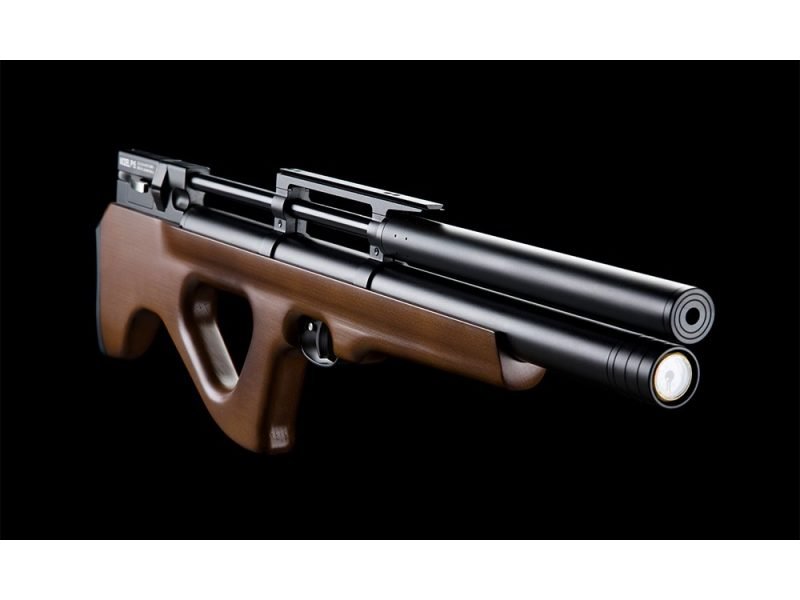
Regulated vs Unregulated PCP Rifles
Unregulated
Air goes straight from the reservoir to the valve. When the reservoir is very full, the high pressure resists the valve opening, so velocity can be slightly lower. As pressure drops, velocity rises to a peak and then falls away. This shape is the power curve, and the useful shots sit in its flat middle. The Gamo Arrow .22 is an unregulated PCP with a 125 cc cylinder and a 232 bar maximum fill.
Regulated
A regulator sits between reservoir and valve and feeds air at a lower, fixed pressure. While the reservoir stays above that setting, every shot gets roughly the same air, so velocity stays consistent. Once it drops below, velocity falls quickly, which is your signal to refill. The Snowpeak P35X Wood .22 pairs a regulator with a 65 cc plenum and 280 cc cylinder, while the Artemis P15 uses a constant (regulated) valve with a 265 cc cylinder.
| Feature | Unregulated | Regulated |
|---|---|---|
| Consistency | Good within the sweet spot of the curve | Very consistent until below the regulator setting |
| Usable shots per fill | Fewer | Usually more from the same cylinder |
| Complexity | Simpler, fewer parts | Extra part that may need servicing |
| Fill strategy | Fill to where your curve starts, not always the maximum | Fill to rated pressure, refill near the regulator setting |
| Best for | Shooters happy to learn with a chronograph | Beginners who want consistency with less fuss |
Fill Pressure: Bar, PSI and the Maker's Rating
Pressures are quoted in bar, psi or MPa. 1 bar is about 14.5 psi and 1 MPa equals 10 bar, so 25 MPa is 250 bar, roughly 3,600 psi. 200 bar is about 2,900 psi and 300 bar about 4,350 psi.
Ratings vary a lot, so always check your own rifle's manual. In our range, the Pallas PCP Bull .22 Synthetic is listed at 200 bar, the Gamo Arrow at 232 bar, the Artemis P15 and P35X at 250 bar, and the Nova Vista Leviathan PS-R2 at 300 bar.
Never fill above the manufacturer's maximum pressure. The reservoir, gauge, seals and valve are designed around that figure. Overfilling gives no useful extra power; on many rifles it causes valve lock and lower velocity, it stresses seals, and at worst it is a real safety hazard.
Gauges are approximate. If the rifle gauge and pump or tank gauge disagree, stop at the lower reading.
How to Fill a PCP Air Rifle: Three Options
PCP Hand Pump
The PCP hand pump is the usual starting point in Pakistan. It needs no electricity, which matters during load-shedding or at the farm. The downside is effort: the last stretch to 250 bar or more is hard work and the pump heats up. Use slow, full strokes, rest when it gets warm, and keep sessions short, because heat and moisture wear out pump seals.
Scuba or Carbon Tank
A filled diving cylinder tops up your rifle in seconds through a valve and hose. You need access to a refill source, a tank suited to your rifle's pressure, and careful handling, storage and inspection of the cylinder. Open the valve slowly so the rifle fills gradually.
Compressor
A PCP compressor removes the hard work and can fill a rifle or tank. It needs reliable power, cooling time between runs and good filtration, since compressors can push moisture and, on some designs, oil into the air. Follow the maker's run-time instructions.
| Option | Pros | Cons |
|---|---|---|
| Hand pump | No power needed, portable, low running cost | Hard work at high pressure, slow, heats up |
| Scuba / carbon tank | Very fast, quiet, many top-ups | Needs refill source, safe handling, bulky |
| Compressor | Effortless, fills rifle and tank | Needs electricity, cooling time, filtration, upkeep |
Moisture and Filters
Compressing air squeezes out its water vapour, and in humid monsoon months that water ends up inside your pump and rifle, causing rust and early seal failure. A moisture filter is one of the best investments you can make.
The PCP Hand Pump Hose Pipe with Moisture Filter is rated to 640 bar / 9,000 psi, with an 8 mm female quick release, an M10x1 pump-end fitting and spare filters and seals. For an inline unit, the Oil and Water Separator is rated for 300 bar / 4,500 psi systems, uses an M10x1 thread and comes with 20 filter cottons. Replace filter media regularly.

Fill Probes, Adapters and Couplers
Most rifles use either a fill probe that pushes into a port, or a male quick-disconnect nipple (often called Foster type) that takes a standard 8 mm female coupler. Probes are usually model specific: the Artemis P15 Filling Probe Nozzle is made for the P15 and fits a standard quick-coupler system. Keep a spare, because a lost probe means no shooting.
On the hose side, a copper M10 quick coupler gives an 8 mm female connection with an M10x1 thread. Check thread types (M10x1, 1/8 BSP or 1/8 NPT) before ordering any fitting.
Shot Count and the Power Curve
Shot count depends on cylinder volume, fill pressure, regulation, power level and calibre. Maker figures are a starting point: the Artemis PR 900 Gen 1 is listed at approximately 35 full-power shots in .22 with 1.0 g pellets.
To find your own numbers, fill to rated pressure and shoot a string over a chronograph, noting the gauge reading at each stage. On an unregulated rifle, the pressures where velocity settles and where it falls away become your fill-to and refill-at points. On a regulated rifle, refill before the point where velocity starts dropping.

Calibres and Magazines
PCPs are commonly made in .177 (4.5 mm), .22 (5.5 mm) and .25 (6.35 mm); the Artemis P15 is offered by the manufacturer in all three. For pest control and field use, .22 is the popular all-round choice, .177 suits target work and .25 favours heavier pellets. Our .177 vs .22 pellet guide covers the trade-offs, and you can browse pellets and BBs to test what your barrel likes.
Magazines are model specific too. The Artemis P15 .22 spare magazine holds nine pellets and fits the P15 only. Never force a deformed pellet into a magazine.

Maintenance: O-Rings and Silicone Grease
A PCP holds air with O-rings, and most slow leaks come from dirty, dry or damaged seals on the probe and fill port.
- Wipe the probe and port before every fill so grit is not pushed inside.
- Use a thin film of pure silicone grease on probe O-rings. Never use petroleum oils or greases on high-pressure air parts. Nitecore SG7 Silicon Grease is a synthetic silicone grease in a compact tin.
- Keep spare O-rings. The Artemis P15 O-Ring Kit covers .177 and .22 versions and includes two fill probe O-rings. Leave internal seals to a qualified airgun technician.
- Never dismantle a pressurised rifle or unscrew the cylinder or gauge unless the manual says it is safe.
- Clean the barrel occasionally. See our airgun cleaning and maintenance guide.

Step-by-Step Filling Checklist
- Make sure the rifle is unloaded, uncocked, magazine out, safety on, muzzle pointed safely.
- Confirm the maker's maximum fill pressure and note the current gauge reading.
- Wipe the probe or port; add a thin film of silicone grease to dry probe O-rings.
- Fit the filter and hose, then insert the probe or connect the coupler fully.
- Close the bleed valve.
- Fill slowly: steady, full pump strokes, or a gently opened tank valve.
- Stop at or slightly below the rated pressure. Never exceed it.
- Close the tank valve, then open the bleed valve slowly to depressurise the hose.
- Disconnect, refit the fill-port cap, and recheck the gauge after a few minutes for leaks.
Safe Storage of a Charged Rifle
- Store it unloaded and uncocked, magazine removed, safety on.
- Lock rifles, pellets and filling gear away from children; see our guns storage range.
- Many makers advise keeping some pressure in the cylinder so seals stay seated. Follow your manual.
- Keep rifles and tanks away from heat, direct sun and hot car boots.
- Never leave a pump or tank connected during storage.
PCP Airgun Accessories and Buying in Pakistan
Before buying a PCP air rifle in Pakistan, decide how you will fill it: a 300 bar rifle needs an air source that can safely reach that pressure. Then plan for:
- An air source with the right rating, plus a moisture filter and matching hose.
- A spare probe, O-rings and silicone grease.
- One or two spare magazines for your exact model.
- A good scope; see our rifle scope buying guide and rifle and airgun scopes.
- A few pellet types to test.
Filters, probes, gauges, couplers and seals are grouped under PCP airguns accessories, and rifles under PCP air rifles. Just Hunters stocks them at our Gulberg, Lahore shop and online, with cash on delivery across Pakistan.
If you hunt, remember that hunting in Pakistan is regulated by provincial wildlife departments. Check licences, open seasons, bag limits and protected species with them first, and only shoot with permission and a safe backstop.
Frequently Asked Questions
What is a PCP air rifle and how is it different from a spring airgun?
A PCP stores compressed air in a reservoir you fill before shooting, and a valve releases a small amount for each shot. A spring or gas-ram airgun compresses air with a piston every time you cock it. PCPs have very little recoil and are easier to shoot accurately, but need a separate air source.
How do I fill a PCP air rifle for the first time?
Make sure the rifle is unloaded, uncocked and on safe. Check the maker's maximum fill pressure, wipe the probe, lightly grease its O-rings with silicone grease and connect a filtered pump or tank. Fill slowly to the rated pressure, never above it, then bleed the hose before disconnecting and check for leaks.
Is a PCP hand pump enough, or do I need a scuba tank?
A PCP hand pump is enough for most beginners and is practical where electricity is unreliable. It is slower and harder work near 250 to 300 bar. If you shoot a lot or fill several rifles, a tank or compressor saves effort. Many shooters start with a hand pump and add one later.
What happens if I overfill a PCP?
Overfilling beyond the manufacturer's rating stresses the reservoir, gauge, valve and seals. On many rifles it also causes valve lock, where the hammer cannot fully open the valve, so velocity drops. At worst it is a genuine safety hazard. Always stop at or slightly below the stated maximum and treat gauges as approximate.
Should a beginner buy a regulated or unregulated PCP?
A regulated PCP is usually easier for beginners because velocity stays consistent until the reservoir drops below the regulator setting, giving more usable shots per fill. Unregulated rifles are simpler and can be very accurate, but you need to learn their power curve and fill only to where consistent shots begin.
Which calibre is best for a PCP in Pakistan?
For most shooters in Pakistan, .22 (5.5 mm) is the most versatile calibre for pest control and field use, with a wide choice of pellets. The .177 (4.5 mm) suits target work and flatter trajectories, while .25 (6.35 mm) suits heavier pellets. Choose by your main use, then test pellet weights.
What maintenance does a PCP need?
Wipe the fill probe and port before each fill and keep probe O-rings lightly coated with pure silicone grease, never petroleum oils. Use a moisture filter, keep spare O-rings and a spare probe, and clean the barrel occasionally. Leave internal seal and regulator work to a qualified technician, and never dismantle a pressurised rifle.
Conclusion
A PCP air rifle rewards owners who understand the whole system: a sensible air source, clean dry air, the right probe and fittings, healthy O-rings and strict respect for the maker's fill pressure. Start regulated if you can, learn your power curve and build your kit of filters and spares from day one. For help matching a rifle, pump and accessories, visit Just Hunters in Gulberg, Lahore, or order online with cash on delivery anywhere in Pakistan.