
A good torch is one of the most useful things you can carry, whether you are walking a field edge before dawn, camping up north or checking the gate during a power cut. Flashlight boxes are full of numbers, though: lumens, candela, IPX ratings, 18650s and 21700s. This guide explains what they mean so you can pick the right light for your use.
In this guide:
- Lumens vs candela vs beam distance, and throw vs flood
- Battery types: 18650, 21700, 14500, CR123A and built-in packs
- USB-C and magnetic charging
- Runtime, turbo, strobe and lockout modes
- Waterproof (IPX) and impact ratings
- Tail, side and remote pressure switches
- Weapon lights and Picatinny / M-LOK mounting for airguns and rifles
- Headlamps and camping lanterns for hands-free use
- White, red and green light for hunting
- Battery safety and care
- Which light suits which job, a buying checklist and FAQs
Lumens, Candela and Beam Distance: What the Numbers Mean
Lumens: total light output
Lumens measure the total amount of light a flashlight puts out in every direction. More lumens means more light overall, but it says nothing about where that light goes.
Candela: how concentrated the beam is
Candela (cd) measures the intensity of the brightest part of the beam, the hotspot. High candela means a tight, punchy beam that reaches far. Under the common ANSI/PLATO FL1 standard, the quoted beam distance is calculated from candela: it is the distance at which the light falls to roughly the brightness of a full moon. A useful rule of thumb is that throw in metres is about twice the square root of the candela figure. So 250,000 cd gives about 1,000 m, while 20,000 cd gives about 280 m.
Throw vs flood
A thrower has a deep, smooth reflector or focused optic and a high candela number. A flood light spreads its output wide, which is ideal for walking, working and camp chores but fades quickly with distance.
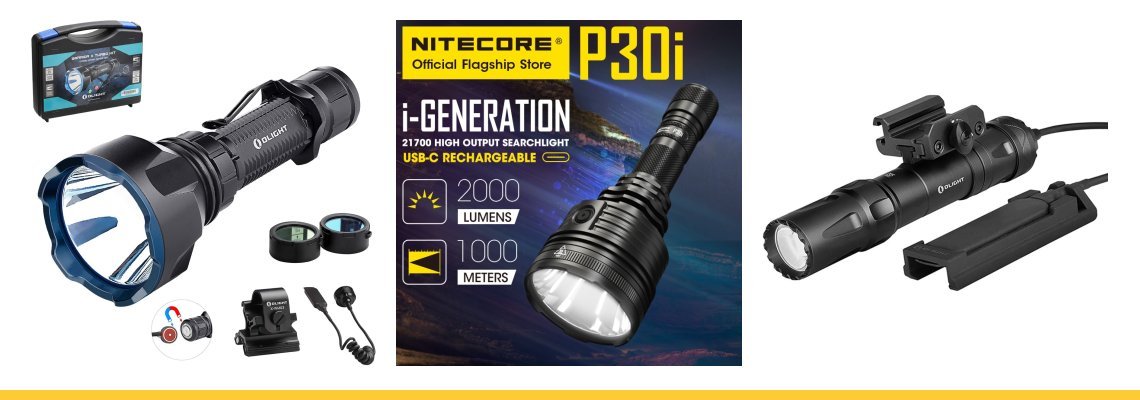
The Olight Warrior X Turbo long-throw tactical flashlight produces "only" 1,100 lumens, yet its 250,000 cd beam is rated to 1,000 m. The Nitecore TM9K TAC 9,800 lumen flood light has almost nine times the lumens but 19,800 cd and a rated throw of 306 yards (about 280 m).

| Light | Max lumens | Peak intensity | Rated throw | Beam character |
|---|---|---|---|---|
| Olight Warrior X Turbo | 1,100 | 250,000 cd | 1,000 m | Concentrated hotspot, soft flood |
| Nitecore P30i | 2,000 | 250,000 cd | 1,093 yards | Long throw |
| Nitecore MH25 V2 | 1,300 | 57,000 cd | 519 yards | All-round, throw-biased |
| Nitecore TM9K TAC | 9,800 | 19,800 cd | 306 yards | Very wide flood |
| Olight Baton 3 Premium Edition | 1,200 | Not listed | 166 m | Compact EDC beam |
Battery Types and Charging
The common cell sizes
- 18650: the long-time standard lithium-ion cell (18 mm wide, 65 mm long). Widely used in full-size tactical lights.
- 21700: a slightly larger cell (21 mm x 70 mm) that typically holds around 4,000-5,000 mAh. It allows higher sustained output and longer runtime.
- 14500: a lithium-ion cell the size of a AA battery but at about 3.7 V instead of 1.5 V. Only use it in lights that state they support 14500; putting one in an AA-only light can damage it.
- CR123A: a 3 V primary (non-rechargeable) lithium cell. They store well for years, making them a good vehicle or emergency backup. Many 18650 lights accept two CR123A cells.
- Built-in packs: common in compact weapon lights, keychain lights and headlamps. Convenient and well sealed, but you cannot swap a spare in the field.
Battery flexibility helps outside big cities. The Nitecore MH25 V2 hunting flashlight ships with a 5,000 mAh 21700 cell plus a battery sleeve for 18650, CR123 and RC123 use. The Nitecore SRT7GT multi-colour flashlight runs on a single 18650 or two CR123A batteries.
One caution: some high-performance lights need specific cells. The Nitecore P30i long-throw flashlight is supplied with a Nitecore 21700 i-series battery, and its listing states that standard rechargeable 21700 and 18650 cells are not compatible.
USB-C vs magnetic charging
USB-C charging lets you top up from a phone charger, car adapter or power bank. Magnetic charging (Olight's MCC system) keeps the light sealed with no rubber flap, but needs its own cable, so carry a spare. For loose cells, an external smart charger such as the Nitecore New i2 Intellicharger handles 18650, 21700, 14500 and many other lithium-ion sizes.
Runtime and Modes: Turbo, Strobe and Lockout
Read runtime tables carefully. The headline lumen figure is almost always a short turbo burst; the light then steps down to protect itself from heat. The Warrior X Turbo, for example, is listed at 1,100 lumens stepping to 600, 300 and 150 lumens over time, with the 150 lumen level lasting up to 12.5 hours. The MH25 V2 lists 1,300 lumens for 3 hours, 300 lumens for 8.5 hours and a 1 lumen ultralow for up to 1,500 hours. The mid modes are what you will actually use.
- Turbo / high: for scanning and identification. Expect heat and step-down.
- Medium / low: walking, tracking a blood trail, camp work.
- Ultralow / moonlight: reading a map or finding gear in a tent without blinding anyone.
- Strobe: a fast flashing mode meant to disorient at close range or signal attention.
- SOS / beacon: emergency signalling.
- Lockout: prevents the light switching on in a bag or pocket. An accidental turbo activation in a bag can drain the battery and get hot. The TM9K TAC, for example, has a dedicated lockout mode.
Waterproof and Impact Ratings Explained
The IP code is an international standard (IEC 60529). The first digit is dust protection and the second is water protection; an "X" means that part was not rated.
- IPX4: resists splashing water from any direction. Fine for light rain.
- IPX6: resists powerful water jets. Handles heavy rain well.
- IPX7: survives temporary immersion, typically up to 1 m for 30 minutes.
- IPX8: survives continuous immersion beyond 1 m; the exact depth is set by the manufacturer (often 2 m for flashlights).
- IP67 / IP68: the "6" means fully dust-tight, plus the water rating above.
Impact resistance is usually quoted as a drop height (for example 1 m, 1.5 m or 2 m) onto a hard surface. For hunting and duck shoots in wet ground, IPX7 or better is a sensible minimum for a handheld torch.
Switch Types: Tail, Side and Remote
Tail switch
A push button on the end cap, operated with the thumb in an overhand or "cigar" grip. Many offer momentary-on with a half press. The Warrior X Turbo uses a two-step tail switch.
Side switch
A button on the body near the head. Easier for cycling brightness. Some lights combine both: the MH25 V2 uses the tail switch for on/off and a side switch for brightness and special modes.
Remote pressure switch
A pad on a short cable that you stick or strap where your hand naturally rests on a rifle fore-end. The Warrior X Turbo's tail accepts Olight's push-to-lock remote pressure switch, and the P30i's USB-C port connects the RSW2i remote pressure switch.
Weapon-Mounted Lights and Rail Mounting
On a rifle or airgun both hands are on the gun, so the light must be mounted. Know your rail first:
- Picatinny (MIL-STD-1913): raised rail with evenly spaced cross slots.
- M-LOK: slots cut into the handguard; accessories bolt directly in.
- Dovetail (11 mm / 3/8"): found on many air rifles for scopes. Usually needs an adapter to take a Picatinny accessory.
The Olight Odin Picatinny rail-mounted light gives 2,000 lumens and 300 m of beam from a 5,000 mAh 21700 battery, with a magnetic remote pressure switch and IPX8 rating. The more compact Olight Odin Mini M-LOK weapon light delivers 1,250 lumens and 240 m from an 18500 cell, with an M-LOK mount included and compatibility with third-party Picatinny and KeyMod mounts. If you want a fore-grip and light in one, the Olight Sigurd angled grip light offers 1,450 lumens and 240 m on a Picatinny mount, fitting M-LOK with an added Picatinny adapter.
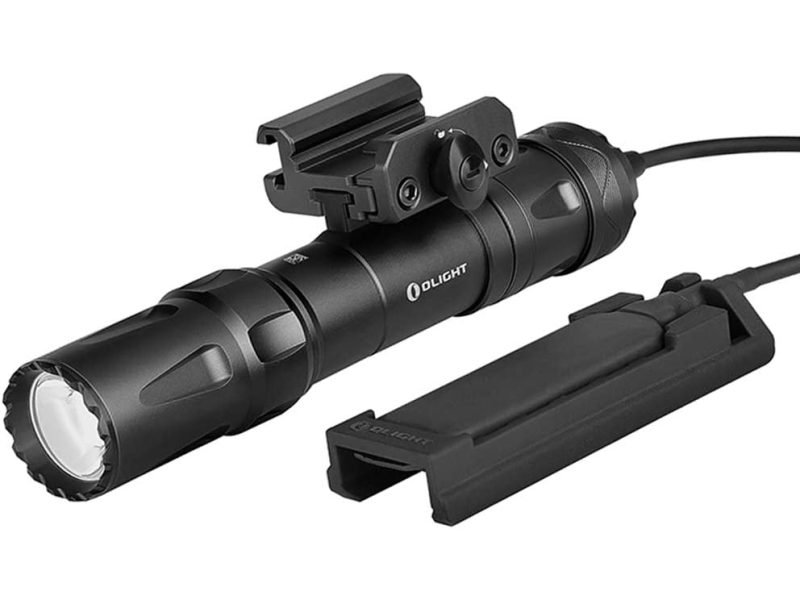
Already own a 1-inch handheld torch? The Olight E-WM25 offset flashlight mount clamps a 25.4 mm body light to a Picatinny rail. Compare more rail-mounted weaponlights in our range.
Airgun notes: spring-piston air rifles have a sharp two-way recoil that can loosen mounts, so re-check screws regularly and choose lights built for recoil. Mount the light so the scope bell does not block the beam and keep the switch where your support hand naturally sits. If you are still choosing a rifle, our guide to the best airguns for hunting in Pakistan and the airguns and air pistols section are good starting points.
Headlamps and Camping Lights for Hands-Free Use
A headlamp lets you dress game, pitch a tent or change a tyre with both hands free. Look for a wide, even beam, a low mode that will not dazzle companions and decent water resistance. The Nitecore NU20 rechargeable headlamp weighs 1.66 oz, gives up to 360 lumens with an 80 m throw, has a 1 lumen low for up to 100 hours, and is rated IPX7.

For a camp or a house during load-shedding, a lantern lights the whole area rather than a spot. The Nitecore LR70 3-in-1 camping lantern works as a 3,000 lumen flashlight, a 400 lumen high-CRI lantern and an 18W power bank, running on two built-in 21700 batteries with an IP67 rating.

Light Colour: White, Red and Green for Hunting
White light is best for identification. Before any shot you must be certain of your target and what lies beyond it.
Red light preserves your own night vision. Eyes take many minutes to adapt to darkness and bright white resets that, so red suits map reading and checking gear.
Green light is popular with hunters for scanning because the human eye is very sensitive to green, so a modest green beam can appear bright. Many hunters also find some animals react less to red or green than to bright white, though this varies by species.
The SRT7GT is a good example of a multi-colour design: alongside its 1,000 lumen white LED it has red, blue, green and ultraviolet secondary LEDs, selected with a rotating ring. Infrared (IR) lights are a separate category; IR is invisible to the naked eye and only useful with night vision or IR-capable devices.
Wherever you hunt, follow the rules of your provincial wildlife department. Night hunting, the use of lights and permitted species and seasons are regulated and differ between provinces, so check current regulations and your licence conditions before you go out. Our article on the hunting season in Pakistan is a useful starting point.
Battery Safety and Care
Lithium-ion cells are safe when treated properly, but store a lot of energy:
- Buy quality cells from known brands. Avoid cells with unrealistic capacity claims, torn wraps or dents.
- Use the correct charger or the light's own cable. Do not charge a 3 V CR123A primary cell; it is not rechargeable.
- Do not leave batteries charging unattended, especially in heat. Never charge in a parked car in summer or on a bed or sofa; use a hard, non-flammable surface.
- Do not store lights or cells in a hot car dashboard.
- Carry spare cells in a case so they cannot short against keys or coins.
- Lock out or unscrew the tail slightly when packing a light in a bag.
- For long storage, keep cells partly charged (roughly half) in a cool, dry place and top up every few months.
Matching the Light to the Job
Night hunting and spotting
Prioritise candela and throw (around 400 m or more), a tail or remote switch, a 21700 battery and IPX8 or IP68. The Warrior X Turbo and P30i are both rated to around 1,000 m. See more in our search lights collection.
Camping and trekking
Choose a headlamp plus a lantern or a floody handheld. Prioritise low-mode runtime, USB-C charging and water resistance. The NU20 and LR70 cover this well.
EDC (everyday carry)
The Nitecore TINI 2 keychain flashlight gives 500 lumens with USB-C charging and an OLED display, while the Olight Baton 3 Premium Edition puts 1,200 lumens and 166 m of beam in a pocket light with a charging case that can refill it up to 3.7 times.
Home and vehicle
For the house, a lantern for power cuts and a high-output flood light such as the TM9K TAC for checking the gate or roof. For the car, keep a light that accepts CR123A backups or keep it charged on a schedule, and store it out of direct sun. Compare the Olight and Nitecore ranges to compare.
If you are in Lahore, you are welcome to visit the Just Hunters shop in Gulberg to compare beams and check how a weapon light fits your rail.
Flashlight Buying Checklist
- What is the main job: spotting at distance, close-range work, EDC, camp or home?
- For distance, check candela and rated throw, not just lumens.
- Check the runtime table for the medium modes you will actually use.
- Battery: built-in or removable? Which sizes are compatible? Any special cells required?
- Charging: USB-C or magnetic? Do you have a spare cable?
- Waterproofing: IPX7/IPX8 or IP68 for outdoor and wet use.
- Switch layout suits your grip; lockout available for carry.
- For gun use: correct mount (Picatinny, M-LOK, adapter) and remote switch option.
- Budget for quality batteries and a proper charger.
Frequently Asked Questions
Are more lumens always better?
No. Lumens measure total output, not reach. For seeing far, a high candela figure matters more.
Is a 21700 better than an 18650?
Generally, 21700 cells hold more energy and support higher sustained output, so they give longer runtimes. 18650 lights are often slimmer and lighter. Always use the size your light is designed for.
What waterproof rating do I need for hunting?
For duck shoots, rain and river crossings, IPX7 or IPX8 (or IP68) is a sensible minimum for a handheld light. IPX4 and IPX6 cope with rain but are not meant for submersion.
Can I mount a flashlight on my air rifle?
Yes, if the rifle has a Picatinny or M-LOK rail, or an adapter for its dovetail. Use a recoil-rated light and re-check the mount regularly.
Which light colour is best for hunting?
White is best for positive identification. Red protects your night vision for map reading and moving around. Green is popular for scanning. Always follow your provincial wildlife laws on hunting at night and the use of lights.
Why does my flashlight dim after a minute on turbo?
That is normal thermal step-down: the light reduces brightness to protect the LED, electronics and battery from heat.
Do you deliver flashlights outside Lahore?
Yes. Just Hunters ships across Pakistan with cash on delivery, so you can order online and pay when your parcel arrives.
Conclusion
Choosing a flashlight becomes simple once you match the beam to the job: candela and throw for spotting, lumens and flood for close work, a headlamp for hands-free tasks and a proper mount for your rifle or airgun. Add a supported battery, a proper waterproof rating and safe charging habits. Ask the Just Hunters team in Gulberg, Lahore, or order online for delivery anywhere in Pakistan.