

A good hunting knife does most of the work on any trip. It cuts paracord, slices onions at camp, trims fishing line and, after a successful outing, lets you dress game cleanly. A poor knife slips, rusts or goes dull halfway through a job. In Pakistan, from the duck marshes of Sindh to the partridge country of Punjab, your knife also has to cope with heat, dust and monsoon humidity.
This guide explains when a fixed blade beats a folding knife, what each blade shape is for, how stainless and carbon steels behave, which handles grip best when wet, and how locks and sheaths keep you safe. We also cover multi-tools and Swiss Army knife style kits for camping, simple knife sharpening, rust prevention, responsible carry and field dressing hygiene, with real examples from the Just Hunters range.
In This Guide
- Fixed blade vs folding knife
- Blade shapes and their uses
- Blade steel basics: stainless vs carbon
- Handle materials, locks and sheaths
- Multi-tools and Swiss Army knife style tools
- Knife sharpening, care and rust prevention
- Safe carry and field dressing hygiene
- Buying checklist and FAQs
Fixed Blade vs Folding Knife: Choosing a Hunting Knife
Fixed blade knives
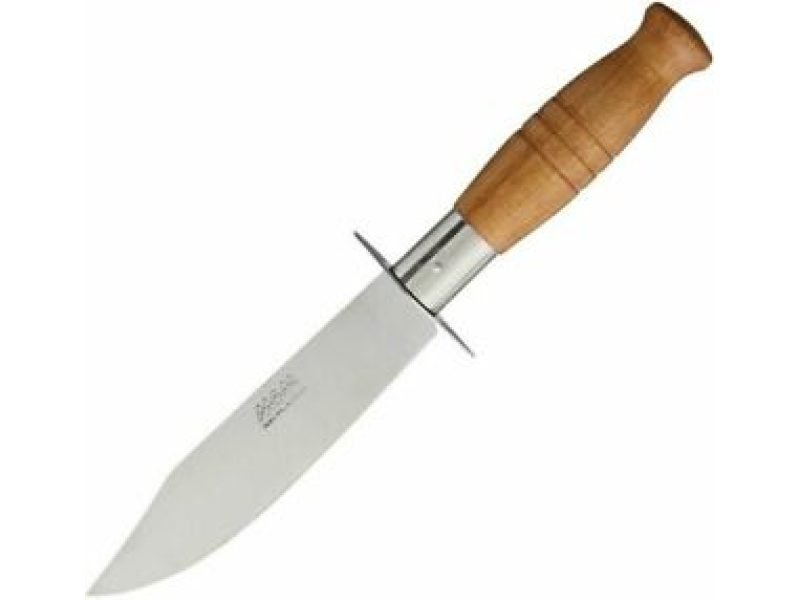
A fixed blade has no moving parts. The blade and tang (the steel that runs into the handle) are one piece, so there is no hinge to loosen or clog. That makes it the strongest and easiest knife to clean after messy work, which is why it is the traditional choice for skinning and field dressing. The trade-off is that it needs a sheath and is bulkier on the belt.
The MAM Knife 70 fixed blade, made in Portugal, is a good example: a 5.25 inch stainless blade with satin finish, full tang, brown wood handle, stainless guard to stop your hand sliding forward, and a brown leather belt sheath, at 9.625 inches overall.
Folding knives
A folding knife tucks its blade into the handle, so it rides in a pocket or on a clip and is far easier to carry all day. For bird hunting, camping and general chores, a sturdy folder with a reliable lock is usually enough. The downsides: the pivot collects blood and grit, and a folder is never quite as strong as a fixed blade.
The MAM 2060 Nr. 12 hunting pocket knife is a classic folder with a 105 mm hand-sharpened German stainless blade that locks automatically on opening, and a dark beechwood handle. For a modern style, the Browning X50 folding knife has an 85 mm titanized 5Cr15MoV stainless blade, a wood and imitation carbon fiber handle, a belt clip, and a built-in glass breaker and seatbelt cutter for vehicle emergencies.

If you regularly process larger game, start with a fixed blade. If you mainly shoot birds, camp and fish, a locking folder is the more practical pick. A small fixed blade in the pack plus a folder in the pocket covers almost everything.
| Feature | Fixed blade | Folding knife | Multi-tool |
|---|---|---|---|
| Strength | Highest, no hinge | Good with a solid lock | Moderate; blade is secondary |
| Cleaning | Easiest | Pivot needs extra care | Many joints to clean |
| Carry | Belt sheath, bulkier | Pocket or clip | Pocket, pouch or pack |
| Best for | Skinning, field dressing | Everyday carry, birds, camping | Repairs, fishing, camp chores |
| Example | MAM Knife 70 | MAM 2060, Browning X50, Buck X61 | Gerber 11 in 1, Swiss+Tech 14-in-1 |
Blade Shapes and Their Uses
Each blade profile balances a strong tip, a controllable point and a curved "belly" for slicing.
- Drop point: the spine slopes gently down to a thick, strong, low point that is easy to control. It skins well and handles camp work, which makes it the most popular all-round hunting shape.
- Clip point: the spine looks "clipped" near the tip, giving a finer, sharper point for piercing and detail work. The thinner tip is more fragile and easier to push too deep, so take care.
- Gut hook: a small sharpened hook on the spine that opens the belly by cutting the hide from the inside outward, helping you avoid puncturing the intestines. Useful on larger game, harder to sharpen, and unnecessary for most bird hunters.
- Skinning blade: a broad, deeply curved belly that separates hide from meat in long strokes. Excellent at one job, less useful for general cutting.
- Straight or utility edge: common on compact folders and ideal for cord, food and packaging. Perfectly adequate for cleaning birds and fish.
Blade Steel Basics: Stainless vs Carbon
Carbon steel is usually easy to sharpen and takes a keen edge, but rusts and stains quickly if left wet, so it suits owners who dry and oil their knives religiously. Stainless steel contains enough chromium to resist rust far better. It is not rust-proof, but it is much more forgiving, which is why most modern outdoor knives use it.
On product pages you will see stainless grades such as 420, 3Cr13, 5Cr15MoV and 440C. Broadly, 420-type and 3Cr13 steels are tough, corrosion resistant and easy to sharpen but need touching up more often, while 440C is a harder, higher-carbon stainless that generally holds an edge longer. Hardness is quoted on the Rockwell C scale (HRC); most of our folders sit between about 55 and 58 HRC, a sensible range for an outdoor blade.
For example, the Browning wood handle folding knife (model 339) uses 440C at 58 HRC, while the Cold Steel Black Sable folding knife uses blackened 3Cr13 at 57 HRC in a 9 cm or 6.7 cm blade size.
Handles, Locks and Sheaths
Handle materials
- Wood (beech, rosewood) looks classic and feels warm, but needs occasional oiling and should not be soaked.
- G10 is a tough fibreglass laminate that grips well when wet. The Browning X78 pocket knife pairs a G10 and steel handle with an 8.5 cm 440C blade.
- Aluminium and steel are strong and slim but can feel slippery unless textured.
- Polymers are light and easy to clean, common on multi-tools.
Choose a handle that fills your hand without hot spots, ideally with a guard or finger choil so your hand cannot slide onto the edge.
Folding knife locks
A lock stops the blade closing on your fingers when you push or twist. For real outdoor work, choose a folder that locks.
- Liner lock: a springy strip inside the handle moves behind the open blade; push it sideways to close. The Buck X61 Mini pocket knife uses a liner lock with a 7 cm 440C blade and weighs 100 g.
- Back lock (lockback): a rocker bar along the spine engages a notch on the blade; press the spine to release. A strong, traditional hunting design.
- Non-locking slip joint: held open by spring tension only, so keep it to light jobs. The tiny MAM Douro key ring knife is a non-locking folder with a 45 mm blade.

Sheaths
A fixed blade sheath must hold the knife firmly and cover the edge completely. Leather is traditional and quiet but can trap moisture, so never store a knife in a damp leather sheath. Nylon dries quickly and suits wet conditions. The knife should not fall out when held upside down, and you should be able to draw and replace it without fingers crossing the edge.
Multi-Tools and Swiss Army Knife Style Tools for Camping
A multi-tool does not replace a dedicated knife, but it is often the most useful item in a camping bag. Pliers pull hooks and bend wire, screwdrivers tighten fittings, a saw trims small branches and openers handle tins.
Among pliers-based tools, the Gerber 11 in 1 multifunctional tool is 440C stainless with needle-nose pliers, wire cutter, knife, double-row saw, file, screwdrivers, openers and a nylon sheath. The Swiss+Tech 14-in-1 pocket multitool adds a fish scaler and hook remover to its pliers, wire cutter, knife and four screwdrivers, with a belt holster.

The classic Swiss Army knife layout places slim tools side by side in one pocket-sized handle: lighter than pliers and ideal for picnics, travel and fishing. The Traveler multi-function portable knife folds eleven tools including knife, saw, scissors, pliers, corkscrew and leather punch, while anglers may prefer the fifteen-function Traveler K5011 pocket multi-tool with fish scaler and hook remover. For a featherweight backup, the Sinclair CardSharp2 credit card knife folds from a flat card into a 420-series stainless blade with a 65 mm edge and weighs 14 grams. Browse more in knives and tools and safety and survival.
Knife Sharpening and Care
A sharp knife is a safer knife: a dull blade needs more force, and more force means more slips. Light, regular knife sharpening beats letting an edge go completely blunt.
How to sharpen with a pull-through sharpener
- Clean and dry the blade so grit and fat do not clog the sharpener.
- Set the sharpener on a stable, flat surface and keep your fingers behind the edge.
- For a very dull edge, use the coarse stage gently a few times. For a slightly dull edge, skip to the fine stage.
- Draw the blade through in one direction, heel to tip, with light even pressure. Never saw back and forth.
- Finish on the fine stage to remove the burr and polish the edge.
- Wipe, dry and apply a thin film of oil before storing.
The Prin Chef two-stage knife sharpener has a tungsten steel slot for dull edges, a ceramic slot for polishing, and a suction base that keeps your free hand away from the blade. It suits straight edges; serrations and gut hooks generally need a small rod sharpener instead.

Rust prevention in humid weather
Monsoon months in Lahore and Karachi, and long mornings in wetland hides, are hard on steel. Even stainless can spot if put away wet.
- Wipe the blade dry after every use, especially after blood, salt, fruit or onions.
- Wash off blood and fat with warm soapy water, then dry thoroughly, including the folder pivot.
- Apply a thin coat of light oil to blade and pivot; use food-safe oil if the knife touches food.
- Store knives out of leather sheaths in humid months, somewhere dry with airflow.
- Treat light surface rust promptly with oil and a soft cloth, then dry and oil again.
- Oil wooden handles occasionally, and never put a knife in a dishwasher.
Safe, Legal and Responsible Carry
- Follow local laws. Rules on carrying knives in public places, vehicles and on flights vary, so check current regulations and carry a knife only when you genuinely need it for hunting, fishing or camping.
- Carry securely and discreetly, sheathed or closed in a pocket or pack. Never display a knife in public.
- Keep knives away from children, stored out of reach, and supervise any young person learning to use one.
- Cut away from yourself, keep others clear, and pass a knife handle first.
Hunting itself is regulated by provincial wildlife departments, which set licensing, open seasons, bag limits and protected species, so always check with yours before a trip. Our posts on the hunting season in Pakistan and hunting in Pakistan give useful background.
Field Dressing Hygiene Basics
- Start with a clean, sharp knife; a dull blade tears tissue and slips.
- Wear disposable gloves where possible and wash your hands well afterwards.
- Work carefully around the abdomen so you do not puncture the intestines or bladder.
- Keep meat off the ground, away from flies, and cool it as soon as possible.
- Clean knives between animals and before using them on food at camp.
- Discard meat that looks or smells wrong, and cook game thoroughly.
Our duck hunting gear checklist covers the rest of your wetland kit, and you will find more essentials under hunting accessories and camping gear.
Buying Checklist
- Decide the main job: dressing game (fixed blade), everyday outdoor tasks (locking folder) or repairs and camp chores (multi-tool).
- Choose a drop point if you want one safe all-round shape.
- Pick stainless steel for humid or wet conditions.
- Match blade length to the work; very long blades are harder to control.
- Check the handle feels secure, ideally with a guard or choil.
- On a folder, confirm the lock engages firmly with no blade play.
- On a fixed blade, make sure the sheath grips the knife and covers the edge.
- Budget for a sharpener and a little oil.
If you want to handle a few knives before deciding, visit the Just Hunters shop in Gulberg, Lahore, or order online with cash on delivery anywhere in Pakistan.
Frequently Asked Questions
Which hunting knife is best for beginners in Pakistan?
For most beginners, a locking folding knife with a stainless drop point or straight blade of around 7 to 10 cm is the best start. It is easy to carry, safe when the lock is engaged, and handles bird cleaning, camp cooking and general cutting. Add a small fixed blade later if you begin processing larger game and need something stronger and easier to clean.
Is a fixed blade or folding knife better for hunting?
A fixed blade is stronger and easier to clean, so it is better for skinning and field dressing larger animals. A folding knife is more convenient to carry all day and is perfectly adequate for birds, fish and camp chores. Many hunters carry both: a folder in the pocket for everyday tasks and a fixed blade in the pack for heavier work.
How do I stop my knife from rusting in humid weather?
Wipe the blade dry after every use, wash off blood and food with warm soapy water, then dry it fully, including the pivot on a folder. Apply a thin film of light oil before storing, and keep the knife out of a damp leather sheath during humid months. Treat any small rust spots promptly with oil and a soft cloth before they spread.
Is a multi-tool or a Swiss Army knife better for camping?
A pliers-based multi-tool is better if you expect repairs, pulling fish hooks or bending wire, because the pliers are strong and versatile. A Swiss Army knife style tool is lighter and slimmer, with scissors, openers and small blades that suit picnics, travel and light camp work. Neither replaces a proper knife for dressing game, so carry one alongside your main blade.
How often should I sharpen my knife?
Touch up the edge whenever it stops slicing cleanly, which for many hunters means a light pass on a fine sharpener after each trip. Regular quick sessions keep the edge in shape and avoid heavy grinding. Use a coarse stage only on a genuinely dull blade, because it removes more metal and can damage an edge that is already reasonably sharp.
Is it legal to carry a hunting knife in Pakistan?
Rules on carrying knives can vary by location and situation, so check current local regulations before carrying one in public, in a vehicle or while travelling. As a sensible practice, carry a knife only when you genuinely need it for hunting, fishing or camping, keep it sheathed or packed away, never display it in public places, and always store knives safely away from children.
Conclusion
The right hunting knife is the one that matches your work: a sturdy fixed blade for dressing game, a locking folding knife for everyday outdoor tasks and a multi-tool for repairs and camp chores. Choose stainless steel for humid seasons, keep the edge sharp, dry and oil after use, and carry responsibly. Explore the full Just Hunters knives and tools range to find one you will rely on for years.