
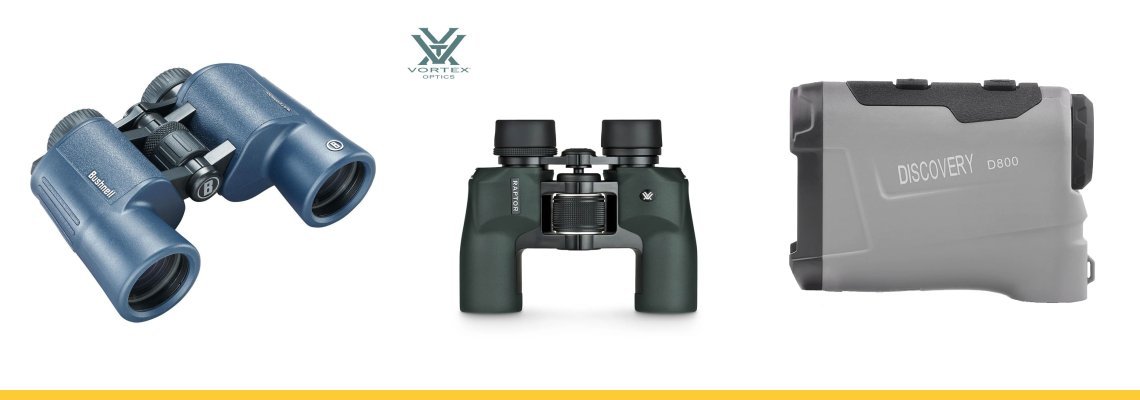
A good pair of binoculars changes a day outdoors. On a winter morning at a jheel in Punjab you can tell a teal from a pintail before the flight is in range. On a northern hillside you can glass a far slope in minutes instead of walking it. But the numbers on the box, such as 8x42 or 10x42, mean little until someone explains them. This guide does that, in plain language, for hunters, bird-watchers and travellers in Pakistan.
In this guide
- What 8x42, 10x42 and 10x50 actually mean
- Magnification vs steadiness, and objective size vs weight
- Exit pupil and low-light performance for dawn and dusk
- Field of view, close focus and eye relief
- Roof vs porro prisms, coatings, ED glass and waterproofing
- Setting the diopter and interpupillary distance
- When a laser rangefinder or spotting scope makes sense
- Recommendations by use, a buying checklist and FAQ
What the Numbers Mean: 8x42, 10x42, 10x50
Every binocular is described by two numbers. The first is magnification: an 8x binocular makes a bird 100 metres away look roughly as it would from 12.5 metres. The second is the objective lens diameter in millimetres, the size of the big front lenses that gather light. So a 10x42 magnifies ten times and has 42 mm front lenses.
From these two numbers you can work out the exit pupil: objective diameter divided by magnification. It is the small circle of light you see in the eyepiece at arm's length. An 8x42 gives 5.25 mm, a 10x42 gives 4.2 mm and a 10x50 gives 5 mm. A bigger exit pupil means a brighter-looking image when the light is poor.
Comparison of common binocular formats
| Format | Exit pupil | Steadiness by hand | Typical weight | Best suited to |
|---|---|---|---|---|
| 8x42 | 5.25 mm | Very steady | Medium | All-round birding, duck flights at dawn, woodland and reed beds |
| 10x42 | 4.2 mm | Steady with practice | Medium | Open country, wetlands, hill glassing, general hunting |
| 10x50 | 5 mm | Steady, but heavier | Heavy | Low light, long sits from a hide or vehicle |
| 12x42 | 3.5 mm | Shaky without support | Medium | Long-distance spotting, ideally braced or on a tripod |
| 10x32 / 8x32 | 3.2 / 4 mm | Steady | Light | Walking hunts, travel, trekking |
| 10x25 / 8x25 | 2.5 / 3.1 mm | Moderate | Very light | Pocket use, travel, boats, daylight only |
Magnification vs Steadiness
More magnification sounds better, but it also magnifies the shake of your hands and your heartbeat. For most people, 8x is the easiest to hold steady and 10x is the practical upper limit for handheld use. At 12x you will usually want to rest your elbows on a vehicle, a wall or your knees, or mount the binocular on a tripod. Higher magnification also narrows the field of view, so moving birds are harder to follow. Simple rule: 8x for moving birds and close cover, 10x for open ground and hillsides, 12x only if you will brace it.
Objective Size, Exit Pupil and Low Light
Duck and goose shooting in Pakistan happens mostly at first light, and many birds and mammals are most active at dawn and dusk. That is when objective size matters. In bright midday sun your own pupil shrinks to about 2 to 3 mm, so almost any binocular looks bright. In twilight your pupil opens to around 5 to 7 mm (less as we get older), and a binocular with a 4 to 5 mm or larger exit pupil will look noticeably brighter than a compact one.
The trade-off is weight. A 42 mm binocular is the sweet spot for most users; 50 mm is for people who sit and watch rather than walk.
Safety first: never look at the sun, or near it, through binoculars, a rangefinder or any optic. Even a moment can cause permanent eye damage. Be careful at sunrise and sunset when scanning towards the horizon.
Field of View and Close Focus
Field of view is how wide a scene you see, quoted either in degrees or as a width at a set distance, such as feet at 1,000 yards or metres at 1,000 metres. A wider view makes it easier to find birds and follow a flight of ducks. As a rough guide, 300 ft at 1,000 yards is about 100 metres at 1,000 metres.
Close focus is the nearest distance at which the binocular can focus. Bird-watchers care about this because small birds in garden hedges, butterflies and dragonflies are often only a few metres away. Under about 5 metres is useful for anyone.
Prism Types: Roof vs Porro
Prisms turn the image the right way up and fold the light path. There are two common designs:
- Porro prisms give the classic offset shape, with the front lenses wider apart than the eyepieces. They tend to give good depth perception and strong value for money.
- Roof prisms give the straight, slim tube shape. They are more compact and easier to seal, but good roof designs need extra coatings and precise manufacturing, which adds cost.
You will also see BaK-4 and BK-7, which are types of prism glass. BaK-4 is generally preferred because it gives a rounder, evenly lit exit pupil with less dimming at the edges. Neither prism shape is automatically better; image quality depends on the whole design.
Lens Coatings and ED Glass
Every uncoated glass surface reflects some light away. Coatings reduce that loss and cut glare. In order of improvement you will see "coated", "multi-coated", "fully coated" and "fully multi-coated", which means every air-to-glass surface has several layers. Fully multi-coated is what you want for dawn and dusk.
ED (extra-low dispersion) glass reduces colour fringing, the purple or green edges you see around a dark branch against a bright sky. It is a real upgrade for serious birding, but none of the binoculars featured here list ED glass in their specifications. For most hunting and travel use, good fully multi-coated optics are enough.
Waterproof and Fogproof
Pakistan's outdoors is hard on optics: winter fog on the plains, monsoon rain, desert dust, and moving from a freezing hide into a warm vehicle. A waterproof binocular is sealed with O-rings. A fogproof one has its air replaced with dry nitrogen or argon gas ("purged"), so moisture cannot condense on the inside of the lenses. For duck shooting and boating, treat sealed and purged construction as essential.

Eye Relief for Spectacle Wearers
Eye relief is the distance your eye can be from the eyepiece and still see the full image. If you wear glasses, your eye sits further back, so you need longer eye relief, usually around 15 mm or more, and eyecups that twist or fold down. Too little and you see a narrow, tunnel-like view, so try binoculars with your glasses on.
Weight, Straps and Harnesses
A 500 g binocular feels light in the shop and heavy after a day in the hills. For long days a chest harness spreads the weight across your shoulders and stops the binocular swinging when you bend or crawl; you can look for straps and carry options among our hunting accessories.
How to Set Up Your Binoculars: IPD and Diopter
Many "poor" binoculars are simply unadjusted. Do this once:
- Interpupillary distance (IPD): hold the binocular and fold the two barrels in or out until you see one single, clear circle, not two overlapping ones.
- Eyecups: twist them up if you do not wear glasses, down if you do.
- Close your right eye (or cover the right objective) and turn the centre focus wheel until a detailed target, such as a sign or leaves around 30 to 50 metres away, is sharp in your left eye.
- Close your left eye and turn only the diopter ring, usually on the right eyepiece, until the same target is sharp in your right eye.
- Open both eyes. From now on, focus with the centre wheel only. Note the diopter setting so you can reset it if it gets knocked.
Care and Cleaning
- Blow or brush off dust and grit first. Wiping a dusty lens grinds sand into the coatings.
- Then use a lens cloth or lens tissue, with a drop of lens cleaning fluid if needed. Avoid shirt tails and paper tissues.
- Keep caps on in dust and rain; after a wet hunt, dry it at room temperature, not on a heater.
- Never open the body; that breaks the seal and gas purge.
Binoculars Currently Available: Matched to Uses
For wetlands, duck flights and boating
The Bushnell H2O 10x42 waterproof and fogproof binoculars are IPX7 waterproof (tested by submersion at 1 metre for 30 minutes), O-ring sealed and nitrogen purged, with fully multi-coated optics, BAK-4 prisms and a rubber-armoured aluminium body. Its 4.2 mm exit pupil suits early mornings at the jheel.
If you want more reach, the Bushnell H2O 12x42 waterproof porro binoculars share the IPX7, nitrogen-purged build with BaK-4 porro prisms, fully multi-coated optics, a 3.5 mm exit pupil, 18 ft close focus and a field of view of 341 ft at 1,000 yards. They weigh 31.1 oz and are tripod adaptable, which is how we would use 12x.
For walking hunts, trekking and the whole family
The Vortex Raptor 10x32 porro binocular is a mid-size option at 18.7 oz, with fully multi-coated lenses, nitrogen purging, a wide 390 ft at 1,000 yards field of view (7.4°), 15 ft close focus and 14 mm eye relief. Its interpupillary range of 50 to 70 mm means children and adults can share it comfortably.

For bird-watching on a budget
The Bushnell NatureView 8x40 porro binoculars use BaK-4 porro prisms, fully multi-coated optics and centre focusing, with a 5 mm exit pupil and 14 mm eye relief listed. 8x is steady for following small birds, and the bright exit pupil helps at dusk.

For travel and boats
The Tasco Offshore 10x25 marine blue binoculars are compact, 100% waterproof with rubber O-rings and nitrogen-purged tubes, and multi-coated. With a 2.5 mm exit pupil they are a daylight glass, ideal for a bag, a boat on Keenjhar Lake or a trip to the northern areas.
When a Laser Rangefinder Helps
Binoculars show you the animal; a laser rangefinder tells you how far away it is. That matters most to air rifle, rimfire and bow hunters, whose projectiles drop sharply with distance. Check:
- Range rating: the maximum is typically achieved on reflective targets in good conditions. Expect shorter readings on dark, soft targets like animals, in haze or in rain, so buy some headroom.
- Angle compensation: when you shoot steeply uphill or downhill, gravity acts over the horizontal distance, not the line-of-sight distance. A rangefinder that reads angle or horizontal distance helps you hold correctly in the hills.
- Optics and power: magnification, a diopter for your eye, and either CR2 batteries or a rechargeable battery.
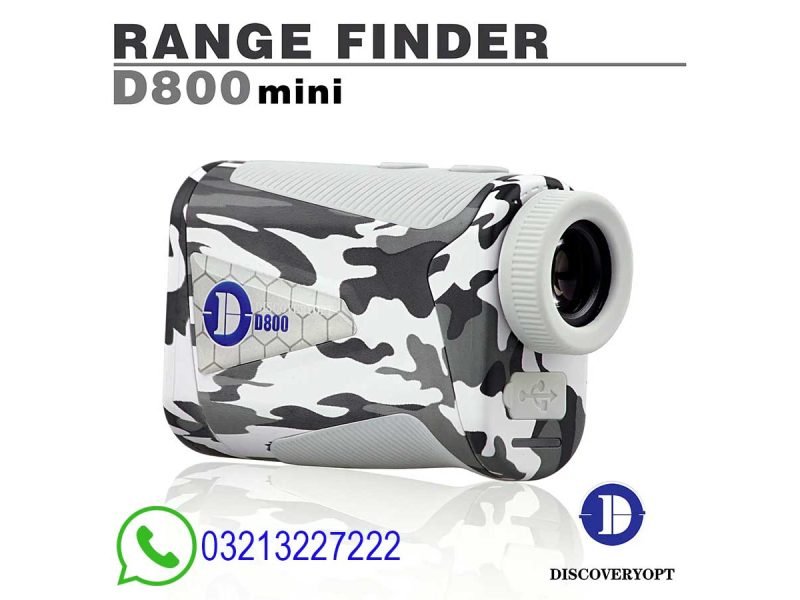
From the current range: the Discovery D800 laser rangefinder with angle compensation is rated 5 to 800 with ±1 metre accuracy, reads angles to ±89°, uses an 8x23 optic and weighs 160 g. The Discovery D600 with angle compensation offers the same compact 160 g body with a 5 to 600 range, which is plenty for most air rifle and rimfire hunters. If you prefer rechargeable units, the Discovery Optics D800 Mini (8x25, 5 m to 800 m) and the Discovery Optics D600 Mini (6x25, 5 m to 600 m) both offer straight-line, vertical and horizontal distance modes with Type-C charging. The T-Eagle 800 camo laser rangefinder has slope, vertical and horizontal distance modes and 6x24 optics, while the Vector Optics Rover 6x25 rangefinder measures 4 to 650 metres with ±1 metre accuracy and adds golf-style modes.
When a Spotting Scope Helps
A spotting scope is essentially a single, high-magnification telescope, commonly in the 20x to 60x range, used on a tripod. It is ideal for checking groups on paper at a target range, counting waterfowl across a large lake and judging distant game on mountain slopes, but it complements binoculars rather than replacing them. We do not have a spotting scope featured in this guide at the moment, but you can browse our full optics and scopes range and our rifle and airgun scopes.
Buying Checklist
- Main use decided: hunting, birding, travel or a mix
- Magnification you can hold steady (8x or 10x for most people)
- Exit pupil of 4 mm or more if you use it at dawn or dusk
- Fully multi-coated optics and BaK-4 prisms where listed
- Waterproof and nitrogen or argon purged for wet or cold conditions
- Eye relief and fold-down eyecups if you wear glasses
- Close focus under about 5 metres for birding
- Weight you will actually carry, plus a strap or harness
- A rangefinder with angle modes if you shoot in hilly areas
If you would rather try before you choose, visit the Just Hunters shop in Gulberg, Lahore, and look through a few side by side. You can also order online with cash on delivery anywhere in Pakistan.
Frequently Asked Questions
Is 8x42 or 10x42 better for hunting in Pakistan?
Both work well. 8x42 is steadier, wider and slightly brighter at dawn, which suits duck flights and close cover. 10x42 shows more detail at distance, which suits open plains and hill glassing.
Are 12x binoculars too powerful?
Not if you support them. Handheld, most people see noticeable shake at 12x. Brace them on a solid rest or use a tripod adapter, and they become excellent for long-range spotting.
What exit pupil do I need for low light?
Divide the objective size by the magnification. Around 4 to 5 mm or more is a good target for dawn and dusk; 2.5 to 3 mm compacts are best kept for daylight.
Can I use binoculars with glasses?
Yes. Look for longer eye relief, generally 15 mm or more, and twist-down or fold-down eyecups. Always try them with your glasses on if you can.
Do I need a rangefinder if I have binoculars?
Ordinary binoculars cannot measure distance accurately. If you hunt with an air rifle, rimfire or bow, where a small error in range means a miss or a wounded animal, a rangefinder is a worthwhile addition.
How do I stop my binoculars fogging up?
Choose a nitrogen or argon purged model so the inside cannot fog. For outside fogging, keep the binocular under your jacket in cold weather and let it adjust before wiping.
Conclusion
Choosing binoculars is simpler once you understand magnification, objective size and exit pupil, then add the features your conditions demand: waterproofing for wetlands, eye relief for glasses, close focus for birding and low weight for walking. Before the next season, read our guide to the hunting season in Pakistan and our wider look at hunting in Pakistan. Just Hunters is happy to help you choose, in our Lahore shop or online.